
The Residents
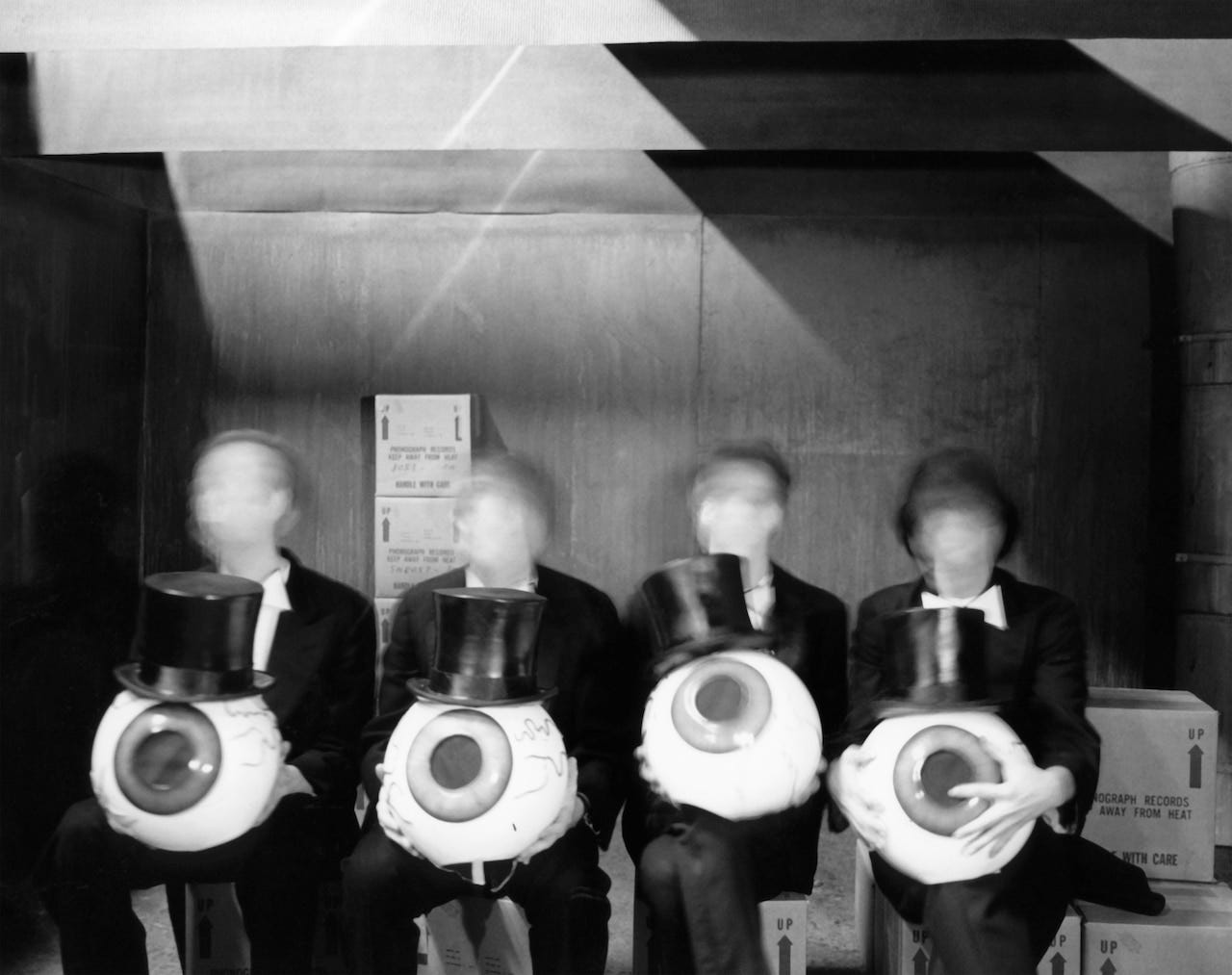
The Residents are an art collective and avant-garde rock band whose decades-long career has been defined by mischief, satire, playfulness, eccentricity, and anonymity. Inspired by Sun Ra, Moondog, and other future-thinking experimentalists from the mid-20th century, The Residents—initially from Louisiana but largely based in the Bay Area—set out to create music unbound by traditional rules. Their catalogue is vast and varied, and alongside numerous classic records—their scruffy and confounding debut Meet the Residents (1974), the multi-suite operetta Not Available (1978), the one-minute jingle extravaganza Commercial Album (1980), and their theatrical epic God in Three Persons (1988)—the group has staged numerous multimedia performances. Over the next few months, The Residents will perform live throughout the US, presenting renditions of material from their pseudo-ethnographic LP Eskimo (1979). Joshua Minsoo Kim spoke with Homer Flynn (b. 1945)—a founding member, graphic designer, art director, manager, and longtime spokesperson for the band—on October 5th, 2026 via Zoom to discuss acid trips, his Southern upbringing, and The Residents’ romantic view of music.
Joshua Minsoo Kim: I know you were born in Louisiana. What sort of things do you remember about growing up there in the 1940s and 1950s?
Homer Flynn: Well, for at least the part I grew up in, it was very straight and very white. The only diversity we had in the South was Black and white. There was no question at that time that Black people were considered and treated as second-class citizens. As a child, you just grow up and don’t really think about these things, and it wasn’t until years later when I read about the Civil War and the South that I really realized certain things. My grandmother lived in a very small town—a population of 200—and had a maid. Her maid’s name was Pearly. I made a connection in my mind to Gone With the Wind and realized how little had actually changed from the 1860s to the 1960s. It wasn’t really until the social upheaval of the 1960s that things started changing.
The Residents are actually starting to work now on a Civil War project. So ultimately, I’ve been discussing all this with them and there’s been a book or two that they’ve passed on to me. I found it pretty fascinating to read about the culture I grew up in and compare it to what it’s like now. Although, in many ways, we’re going through a strange time in the United States—it feels like we’re going backwards. It felt like the values that were so dominant in the South during the 1960s were moving away for a while, but now those values are accepted and embraced all over the country. I find that disturbing.
You’re a graphic designer and have designed the covers for The Residents’ albums. When did you first really get interested in art? Was there a piece of music or literature or visual art that really struck you early on?
I always liked art. I liked to draw when I was a kid, and when I was in the first grade, I actually did a finger painting of a bowl of fruit that won an art contest—it was in the State Exhibit Building for a month. My mother wanted me to take art lessons, and I took some for a while, but honestly I really didn’t like having to get on a bus when school was over and go all the way across town. And these artist people I took lessons from were weird as far as I was concerned (laughter). After doing that for a year, I was given the option to continue and I said no. I didn’t do any art at all for years and years, and it wasn’t until I got into college that I returned. I had some friends who were running for political office in the school and they needed help with their campaign. I started doing artwork for them and that’s when I got back into it.
What did you go to Louisiana Tech for, then?
Engineering. My father was a civil engineer. He was a builder. I was always good at school—at math and science—and I was offered a scholarship. I didn’t really have any sense of direction in terms of knowing who I was and what I should do, but because my father was an engineer and I got a scholarship to an engineering school, I thought I should do it. I did that for about a year and a half—I didn’t particularly like it—and at that point I changed to history, and that was my first initial step down a personal path. There was this history teacher that I really liked a lot, and that’s what got me started. But after about six months… well, I was always a big reader, so I majored in English. I never really took art in school—I’m purely self-trained.
So you went for engineering, switched to history, and then switched to English?
Yes. And then I dropped out shortly after that. I was never terribly academic. I felt that the thing that was most beneficial to me about college was knowing how to deal with social situations.
Like what?
Dating. I was in a fraternity for a while, and the fraternity… I didn’t particularly like it, and I dropped out of it when I dropped out of college, but at the same time it put me into contact with a lot of people. I wasn’t exactly socially adept when I was young, and I was able to learn more of that.
So what brought you to San Mateo?
I wanted to leave the South. When I left the South in the beginning of 1969, this was George Wallace times. George Wallace was one of the original Trumps. I really did not care for him, but he was quite popular in a lot of ways and I wanted out. I wound up in San Francisco, and for a while in San Mateo, mainly because I was offered a landing spot. I would always say that if I had a landing spot in New York I would’ve ended up there, but ultimately I wound up in California.
How did that landing spot arrive?
I had a friend. He was one of my good friends. We actually went to elementary school together, though we weren’t really friends then. We ultimately went to college together and kind of stayed friends. He was a really interesting guy. He was half French. His father was a West Point graduate—he went to France at the end of the War, got a French woman pregnant, and actually came to Shreveport. She actually came to Shreveport, too, and stayed there for five or six years—I don’t know how she stayed that long (laughter). She ultimately went back to Paris, which meant that every summer my friend would go to Paris. He spoke French and was much more sophisticated than my other friends. I’m trying to remember what got him to California… but he had an apartment in San Bruno, I think. He said I could stay with him. I had a Volkswagen Bug at the time, and he and I drove out to San Bruno in January of 1969.
Did you take your time to get there?
We took our time. It was a fun trip.
What things do you remember about that trip?
One of the things I remember, and you’re probably not aware of this, but those Volkswagen Bugs would have to have valve jobs. Mine was due for a valve job so I had it done just before I left, but one of the things is that you had to have it checked after 200 miles. That’s the distance from Shreveport to Dallas. We drove to Dallas, left the Volkswagen at a dealership, and discovered that the Jefferson Airplane was playing in town. He and I went to that Jefferson Airplane concert, and it was great. We were barely able to get the car before the place closed, and then we drove on out from there.
You said that you wanted to get out of the South. Did you want to escape the South early on?
That started when I was a teenager. I knew that the world was a much bigger place than the South and I was really interested in exploring beyond that. The first time I got out of the South—like I said, I dropped out of college—I ended up getting a job testing pipelines. They sent me to Pennsylvania. That’s the first time I really got out of the South, and I really enjoyed being in new places and meeting new people. One of the more notable things was when I got sent to test a pipeline in Eastern Pennsylvania, which was almost in New Jersey. I had a little time off, and I went to New York for the first time. I went to a place called the Night Owl Café. The Lovin’ Spoonful had a song that was pretty popular just in the New York era: “Do You Believe in Magic.” At the time it was only a hit in the New York era—they were a New York band—and I just loved it. So the more I got around and made more contacts, I knew I wanted to get out of the South.
So you went to New York in 1965?
Yeah, when I was 20. [Editor’s Note: Listen to a live performance from The Lovin’ Spoonful at the Night Owl Café in 1965 here].
Your road trip happened in 1969. What happens in the interim?
I had a job as a dispatcher for a concrete company. I sat in a little office and I had about four or five telephone lines, plus a microphone to the trucks, plus an intercom internal to the office, all of which could go off at one time (laughter). So when it was busy I’d go crazy, but other times it’d get real slow. I’d take orders for concrete and then dispatch trucks to fulfill those orders.
What was it like when you finally landed in California? What did you wanna do when you first got there?
I was a big fan of the music scene in San Francisco during the mid-to-late ’60s. I went to as many shows as I could. I remember going to The Fillmore and seeing Jefferson Airplane again, I remember seeing Country Joe and the Fish, I remember seeing the Grateful Dead. I went to a free concert in Golden Gate Park where Jefferson Airplane played for two hours and the Grateful Dead played for four hours. And I had my share of marijuana at the time, so I was blissed out (laughter).
This is an interesting and important time to move out to California. I don’t know how quickly soon thereafter all The Residents stuff started to happen, but what was it like to live life there with [Residents co-founder] Hardy Fox?
I was friends with The Residents back in Louisiana. There really was no group at the time—they were all friends, and it was a collection of odd and curious outsiders. They came out to California separately, more or less around the time I did. I think they had been out for a year or two when they ultimately decided that they were going to start doing music. And the interesting thing about them to me, and this is what really attracted me, is that they weren’t trained musicians—they were self-taught. When they started, they had this idea that, “Okay, if we can get a group of us together, even though we don’t know how to play instruments, we’ll figure it out and it’ll be based on our own personal values. It won’t be based on the rules of music that have been around forever; we’ll create our own set of rules.” I was a big fan of Sun Ra, and what I saw with The Residents was a similar aesthetic. I mean, Sun Ra was trained, but at the same time he was real loose in terms of how he put music together. Of all the concerts I’ve ever been to, of the top 10, about half of them are Sun Ra concerts.
Tell me about the Sun Ra concerts you went to. What stood out?
Sun Ra was originally in New York, and then he was in Philadelphia for a while, but he would come out to the Bay Area and stay for six months at a time. He would bring his hardcore group with him, but I don’t think that was more than a half-dozen people. He also brought a lot of costumes. The longer he was here, the bigger the group would get—he attracted all these interesting people. He’d pop up in different places around town, and there was an old movie theater that I remember going to twice on Saturday afternoon. And literally, there were more people in the band than there were in the audience. He’d have 20 or 25 people on stage and there’d be 15 of us in the audience, and they couldn’t care less. They were having a great time, and he had these kind of things that he’d sing and chant. “It’s after the end of the world, don’t you know that yet?” And they’d start chanting that over and over again, and then the whole group would start marching around the theater. It was just very loose and unconventional, and that made a big impression on me.
You noted that the group had their own personal values. They’ve talked a lot about the “Theory of Obscurity” [the idea that an artist does their best work when working in obscurity, as to not be influenced by external feedback] and the “Theory of Phonetic Organization” [the idea that artists don’t need to follow established ideas about music, instead valuing sound over meaning and structure, both lyrically and musically]. But given you were from Louisiana and you felt all these people were unique, and the fact they had enough of a drive to come to California, what do you feel were these personal values that informed the music?
First off, I think it was a very outsider mentality. Once again, The Residents are not trained musicians. They’re not in the know. They have some friends who are musicians, but they don’t really hang out and jam. I had a friend, and he was my best friend in Louisiana for a while. His father was a graduate of Princeton. He had a 160 IQ and was a theater designer. His wife was a ballerina. Compared to all my other friends, they were really unique and very interesting. Part of what was interesting with them was that they’d traveled around quite a bit as he worked as a theater designer, and they ultimately decided to settle in Shreveport. I found it weird, but on the other hand they were ready to raise a family and felt this was a good place to do that. I can understand that. His parents were definitely an influence on me at the time. The father was a consultant for people building theaters, and there is a college in Shreveport called Centenary College—it’s a Methodist college—and he was the consultant for its theater.
So you were inspired by the fact that this guy had a unique job?
I would have dinner with him, and the conversations were completely different from the conversations I had with my parents or with anybody else’s family. They were much more sophisticated.
It’s interesting you use the word “sophisticated” again. When you use that word, I’m assuming you mean someone who’s more cultured and worldly.
More cultured, more education, more awareness of culture as opposed to having a narrow mind.
Do you think sophistication was something that The Residents aspired to, albeit through their own circuitous path?
Well, I’m a big fan of diversity. I remember on my first trip to New York, my mind was blown by how many different cultures mingled there. I felt the same thing when I had my first trip to San Francisco in the summer of 1968. To me, knowledge and awareness and interest in that kind of diversity… if you’re open-minded, it creates sophistication.
Were you and other members of The Residents involved in protests at all? A lot was happening in the 1960s obviously, but then also at the beginning of the 1970s. There was Kent State of course. Vietnam.
The Residents are not especially political. They have touched on political things in small amounts over the years. Personally, I remember going to a few political rallies, but I never got terribly interested in them. I found that these things quickly became “us versus them.” I’m not a believe in “us versus them.” I believe more in, once again, a certain kind of diversity. I believe that everyone has their own values and should be allowed to have their own values. I don’t believe in conflicting with people, I believe in talking with people and trying to get to understand them. The more I’ve gotten to understand people… usually if you understand someone, it’s difficult to conflict with them. And that’s one of the things I have problems with now, that conflict can come very quickly and easily.
Was there ever conflict within the group? Like, did there have to be meetings to discuss specific problems?
Yeah, there’s been conflict. There was a point where I thought they were gonna break up.
When was this?
I would say in the mid-to-late ’70s.
What happened?
Well, it was a romantic situation (laughter). That’ll do it, right? Two of the members were involved with the same woman, and then ultimately… and they probably don’t want me talking about this… but two of them got involved romantically around the same time, so there was all this romantic energy flowing back and forth. It looked like the group was not gonna be able to contain it. And all of that energy flowed into their Not Available (1978) album. As the residue of it hung around for a while, a lot of it also flowed into the God in Three Persons (1988) album, which was a while later.
What do you mean that it flowed into Not Available?
The album provided a direction for their negative energy. By focusing on that instead of on each other, it created a positive outcome. There was a different point of fixation.
How did it come back again on God in Three Persons?
As I understand it, God in Three Persons is about dependence. One of The Residents found himself in two codependent relationships at the same time. Creating the album became a positive way out of this situation.
Being involved with The Residents over the years, what do you think you’ve learned about yourself? How do you think you’ve grown? And I’m not even talking about growing as an artist, but there’s this interesting specificity to the project because of its insistence on anonymity. There are all these things that happen in private, and there’s nothing in terms of a public persona that you have to manage—you don’t have to think about how the public views a specific member, which would interfere with egos.
You mentioned egos and part of the thing about The Residents is that it’s low-to-no ego. With most groups, you have people who are trying to stand out as much as they can, but with The Residents, they have a strong belief in group identity. They feel like they’re capable of doing more as a group than as individuals, where each one’s trying to get as much attention for themselves as possible. They all like having this credit coming to The Residents as a group, and then attention dribbles its way downwards. I learned a lot from that. Everyone needs an ego to get anything done, but on the other hand, if you put too much of your identity into your ego… well, that’s not very positive. The more identity you put into it, the more you push people away.
You mentioned that you were smoking weed when you went to California. I’m curious how much you feel drugs impacted The Residents throughout their lifespan.
There were a lot of psychedelics back in the early years. For me, I can remember one time when I took acid… and the thing is that it didn’t have to be real strong, but it’d take up two days. It’d be one day of just going out and trying to experience the world in your crazy, hazy, acid-influenced way. And then it’d take another day to recover. When you first start, that first day is filled with magic. You feel like you’re one with the universe, that you’re communicating with God. It opens you up in so many ways and it’s amazing. But I remember getting to a point, after I had done it a few times, where all of a sudden I felt… I’m not talking to God, I’m just on drugs (laughter). And it’s gonna take me another day to recover and get back to what I’m doing! At that point it lost its magic, and I haven’t really done it since then. I went probably 10 or 20 years without doing anything, but now that marijuana is legal, my wife and I might take a few puffs every week or two.
Do you feel like there was a correlation between the trips you guys had and the music you wanted to make?
Someone that gets stoned will start making music and they’ll think it’s the most amazing thing that’s been done. I’ve been around The Residents at times when they said, “This is the most amazing thing! Let’s record it!” And I’ve been there when they went back to those recordings and went (in a disgusted tone) eughhh. It’s a different state of consciousness being on drugs and not on drugs.
You said that you got into graphic design in college. What sort of things inspired you in terms of visual artists? Were there specific painters or graphic designers or films that were especially influential?
All of the above, really. I’m a huge fan of M. C. Escher, I love his stuff. And how can you not like Picasso? So all of that stuff was influencing me, but ultimately you want to find your own path as an artist. I started doing silkscreening and I really enjoyed that quite a bit. That was my first step into graphics, really. Kodalith was a type of film that was primarily used in printing. It’s a kind of film that resolves everything into black and white. You would make something into a Kodolith first… with most printing, you create several different plates, and then those plates print one on top of another and that creates the final image. They used to use Kodolith as the in-between—between the artwork and the printing plate. I started playing around with it in the dark room and it was an interesting medium for me.
I know that The Residents were inspired by Sun Ra, Captain Beefheart, and Moondog. Were there touchpoints outside of music—film, television, art, literature? Did any of that affect how the group approached the music?
They were big Federico Fellini fans. If you think about it, you can probably see it in their work. It was just the possibilities of art and creativity in general. I was still in Shreveport when 8½ (1963) came out. There was one small art theater in Shreveport—and they probably don’t even have one anymore—and 8½ was getting a lot of attention. I went to see it, and from my point of view I thought it was shit! (laughter). Like, this didn’t make any sense at all! It wasn’t until four or five years later, after I’d had several acid trips, that I saw the film again and it suddenly made sense. I understood what it was all about. Once again, it’s all about creativity and putting things together in ways that are unexpected.
I’m thinking about your move to California in 1969. Around this time you have Fellini Satyricon (1969) and The Clowns (1970). Those two works feel especially relevant for The Residents’ music.
Yeah, Satyricon in particular. It just meanders from one crazy situation to another, each one beautiful and elegant and fascinating.
Were there any musicians that The Residents were fans of that listeners may be surprised about?
In addition to the more Moondog and Frank Zappa-type artists, The Residents were fans of a lot of blues. The major event of my high school was graduation. You’d go to senior prom, which was boring and straight and you’d put on your tux and your girlfriend would put on an evening dress—whatever. That would go on from 8pm to midnight. But then from 2 to 6am, they had something called the German Dance. And don’t ask me why it was called that. It’s one of those things you just accept when you’re young; it wasn’t until later when I reflected and thought, “German Dance? What the fuck?” (laughter). But anyway, the German Dance for my senior year, which was 1963, Bo Diddley played for it.
Whoa, that’s crazy.
And it just blew my mind! I thought he was just fantastic.
What about the blues spoke to The Residents?
To me, the most important thing about the blues is that there’s a sense of authenticity. There’s a sense of emotion that you believe and buy. All popular music is not like that. Some of it feels like it’s just for the moment.
It’s interesting to think about authenticity with a group like The Residents, as satire and absurdity is such a big part of the group’s ethos. Though, these sort of complex and conflicting emotions can really speak to human experiences in ways that something more straightforward can’t. Did The Residents talk about authenticity a lot and how to achieve that in music?
No, it was more of an instinctive thing. The Residents were also big fans of Kurt Vonnegut. There’s this interesting combination of the darkness of life in a realistic sense to then be combined with absurdity. That says a lot in terms of The Residents’ values, really.
I wanted to touch on Eskimo (1979) and the new Eskimo Folk Songs (2026). It’s hard not to think about Nanook of the North (1922) and the way this document was fictionalized. What was it like to revisit this album and to revisit these ideas?
The Residents have always been fairly huge music fans. It was the San Francisco scene that attracted them in the mid-to-late ’60s. When you’re into music, you’re always looking for something new. As they continued to go through things that were obvious and available to them, they started getting more interested in what was referred to at the time as “ethnic music.” And that’s what they wanted to do. At the same time, they didn’t want to feel like they were imitating, say, Indonesian gamelan music. They wanted to do their own music but feel like it was connected to culture in a certain way.
The interesting thing about Inuit culture was that nobody knew anything about it. It was a wide-open playing field. They researched it a lot, and it turned out that they didn’t find a lot of the authentic music to be interesting. And that’s okay, because they didn’t care for imitation. One of the primary ideas beyond creating so-called “ethnic music” was that they wanted to make something different that nobody was familiar with. At the same time, they wanted to do an album that told stories, and it was important that they told stories with sound. And from their point of view, the sound of wind was just as important as this fictional band they had.
It was an interesting time for a lot of music like this. Jon Hassell was making music that would end up becoming what he called “Fourth World” music. Harumo Hosono was sort of riffing on all this by doing his take on exotica, which of course goes all the way back to Martin Denny. I’m curious if there were conversations about this sort of imagined music at the time.
The Residents were big Martin Denny fans. To bring in this idea of exotica… it was the idea of a romanticized version of something that never really existed. The Residents loved that. And ultimately, The Residents see music in a very romantic way.
I’m curious, were The Residents aware of Sun City Girls at all? Were they fans of their music? It’s hard not to think about that band as being a continuation of the sort of ideas presented on Eskimo.
They were aware of them but I can’t say that any of them were fans.
I don’t have any more questions. Is there anything you wanted to mention about the band or this upcoming tour?
The Residents are really looking forward to the tour. The album, Eskimo, is close to 50 years old. It’s something they’ve touched upon over the years, but they never felt like they got to the heart of it from a performance standpoint, and hopefully they’ll be doing that now. They’re really looking forward to it and for the album to be back in the world again.
There’s a question I end all my interviews with and I wanted to ask it to you. Do you mind sharing one thing you love about yourself?
Honestly, one of the things I love about myself is that I’m happily married and I have two daughters. I feel really good about my relationships with them—they’re very strong, fundamental parts of my life.
The Residents are currently on tour throughout the US presenting material from their 1979 Eskimo album. All tour dates can be found at their website.
Thank you for reading the 243rd issue of Tone Glow. Let love leak out.
If you appreciate what we do, please consider donating via Ko-fi or becoming a Patreon patron. Tone Glow is dedicated to forever providing its content for free, but please know that all our writers are paid for the work they do. All donations will be used for paying writers, and if we get enough money, Tone Glow will be able to publish issues more frequently.