
No.006
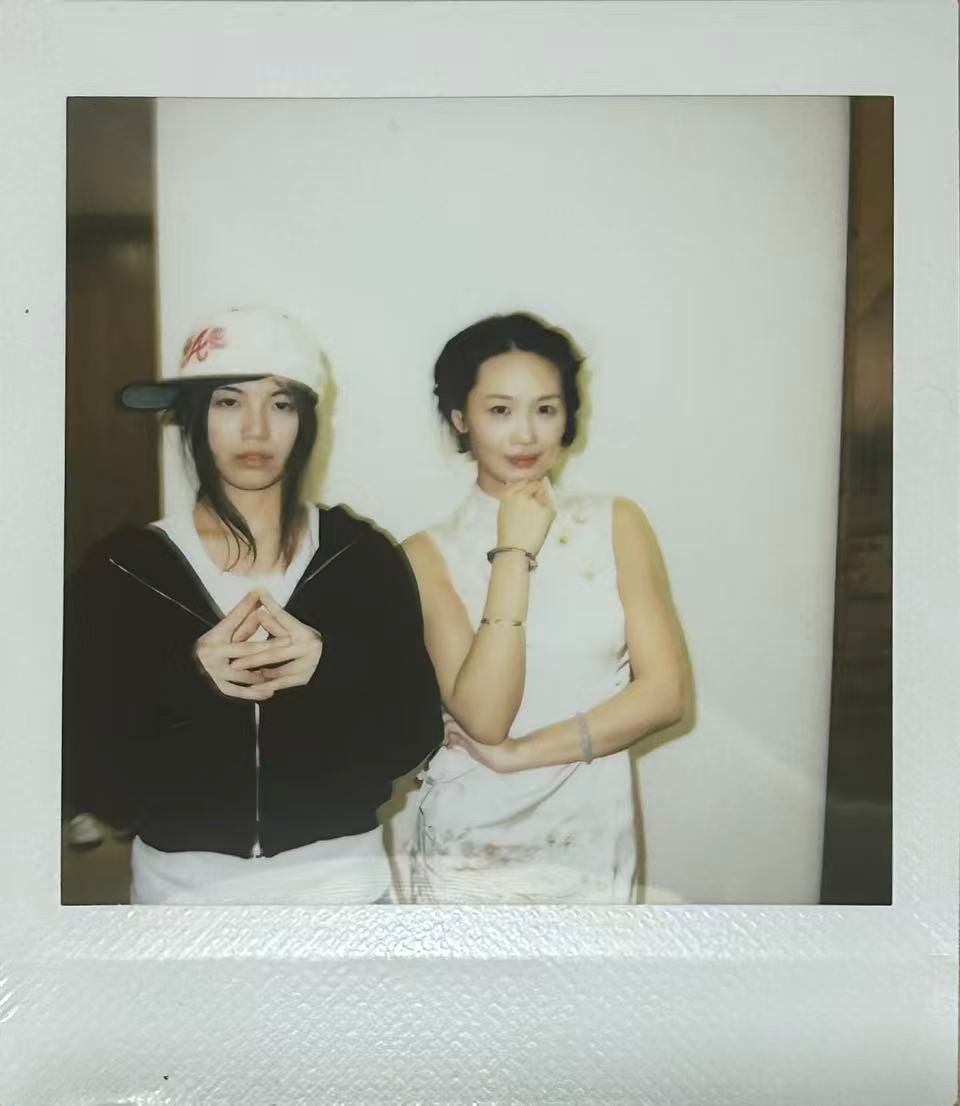
No.006 is a Chinese art collective spearheaded by the visual artist and musician Huang Hanqiu (b. 2004). Born in Chongqing, Huang began her arts practice as a painter before eventually expanding to music. Alongside longtime friend Evol (b. 2000), the two started making music within the past year—Huang produces and writes lyrics while Evol sings. Last month, No.006 dropped their debut EP, 001, which featured electropop, 2-step, ambient, and more. In a few weeks, they’ll drop their next project, 003. Joshua Minsoo Kim spoke with Huang on October 3rd, 2026 via Zoom to discuss how she began producing, being inspired by Chinese underground rappers, and the plans surrounding her intercontinental album release party. Special thanks to Wen Xuanxi for interpreting.
Joshua Minsoo Kim: Where were you born? What are some early memories you have of growing up there and engaging with art?
Huang Hanqiu: I was born in Chongqing, which is a city in the Southwestern part of China. I think being born in China has had a big impact on my work just because it’s really different from other countries, even if we only think about specific policies and the typical social environment. In general, I was always more involved in fine arts than music, and I started with painting. The first memory I have related to art is from when I was a kid, about 10 years old. I was taking an Italian-language class with an Italian teacher, and at one point I wasn’t really paying attention. He scolded me. I ended up drawing him in my notebook, and I made him really ugly (laughter). I drew three lines underneath him [like a rocket taking off] to show that I wanted to drive him off this earth. That was the first time I used art to convey my feelings, and it was also the first time I realized that art can break boundaries between different cultures.
After this experience did you take art more seriously? Did you take classes or spend more time at home painting or drawing?
In China, parents really like to send girls to dance classes. When I was in kindergarten, my parents sent me to learn dance—ballet and Latin—but I didn’t really like it, and I think it’s because I don’t relate to my body in that way. It feels like an artform that doesn’t require my brain to do any work, at least for me. Later, I wanted to learn to paint but my dad didn’t agree with what I thought. He told me I could learn to paint on my own, that I didn’t need to go to an art school, but I felt that painting was something that really involved your mind instead of just your hand. He still didn’t agree with me by the time I was in junior high, but when I was in high school, I went to see this teacher. I sent him my drawings via WeChat every day and he eventually took me on as a student. That’s when I learned to paint. I had another personal motivation for studying art, too. In China, students have a lot of school work and face a lot of pressure. If I could learn art, I wouldn’t have to stay at this school—I could go elsewhere, I could have my own cell phone, I could do my own makeup, I wouldn’t have to wear these school uniforms.
I’ve seen some of the paintings you’ve posted on Instagram and Xiaohongshu and you have a lot of work depicting women’s bodies. I’m curious how painting has helped you explore and think about ideas regarding femininity, womanhood, and even yourself.
Early on, I’d post paintings on the internet and nobody paid attention to any of them. I still felt happy doing that, though. I like to paint the body because I’m a girl myself and when I try to think of a model, I think of what’s familiar, and it’s these images of women. When I see them I think of these beautiful lines, and I use these lines to convey their beauty. When I draw them, they’re definitely different from realistic figures, but the differences in my lines can express specific feelings. For example, when I want to depict a softer image, I might use curly or uneven lines, but when I want to depict a stronger, angrier figure, I’ll maybe use straight lines and depict someone who might not be considered beautiful by most people. So, I was initially just exploring with lines and color.
I’ve seen photos of you from years ago where you have a guitar. How did music first come into play with your artistic practice?
So, I’m doing No.006 with Evol. She sings while I handle the production and write the lyrics. I met Evol about eight or nine years ago, when I was in my first year of high school. I was already making music by then, and there were a lot of underground musicians in China at the time, too. There was so much schoolwork that I had to do, but instead of doing that I was just focusing on social media. I was posting stuff and was already getting money from that. I felt different from other people around me, to be honest, and I wanted to hang out with older kids.
I ended up getting along with these university students. Every day, they’d come and pick me up from my high school and, during weekends, I’d stay at their place. They had a recording studio too, and because we were friends I could use it for free. We’d look for beats on the internet, on YouTube, and convert videos into mp3s and then sing over them. I don’t think that I’m a bad singer, but there were some bad experiences I had that made me want to stop singing. So, I don’t sing anymore, I just make beats. I knew Evol and got along with her, but from my third year of high school onwards—and through all four years of university—we didn’t talk to each other. We had a falling out. But in the past year, we started talking again. And that’s when we started No.006.
Who were the underground artists you were listening to? What was exciting at the time?
A lot of the musicians I knew back then left a big impact on me. They were underground rappers, and they were different from others at the time. So many Chinese rappers just talk about things that they think make them seem cool and hot, but the rappers I liked would rap about abstract and funny stuff. It wasn’t cool at all; they’d just rap about stuff happening in their life. This is also true for me: I like to write lyrics about my everyday life.
Who were these rappers?
The group already split up, and I might’ve been one of the reasons it happened. I got into a relationship with one of them and it got a bit messy those involved. They were called 三和青年 [“Triple Peace Youth Gang”]. When they started they were quite popular, but after they split up some of them stopped making music while others continued. [Editor’s Note: A flyer for a Triple Peace Youth Gang festival performance can be found halfway down this page].
You have your single, “uang1zh.iao3d” [装屌 aka “Pretending to Have a Dick”], where the lyrics say something like, “The world doesn’t give a shit about me” and “I’m a slippery piece of meat.” Can you tell me how you’re approaching your lyrics in general? How do your songs come together?
“Pretending to Have a Dick” was the first song I wrote. At first, I didn’t know how to produce songs so I learned from my producer friends. We were in Chongqing and I went to Chengdu for university. We didn’t hang out that much once I moved, but later on some of them moved to Chengdu as well and I’d hang out with them. There was this one time when they were just watching a Counter-Strike livestream. I didn’t care about that and didn’t want to watch so I grabbed a computer and made a beat, and that just came from my visual understanding [of the DAW] and from hearing what came out. I showed them the beat and they thought it was pretty abstract. Then I went home and downloaded FL Studio and made a beat again. I sent it to the group chat and they thought it was awesome. They were surprised, saying they didn’t know where this talent came from. I asked them if they thought I should sing on it, but they thought it might be better if it stayed as an instrumental.
One day I got into a fight with my father and it was about buying clothes—he thought they were too expensive. And at the time, I was quite in love with a boy in this friend group, and he became my boyfriend later on. But in the group chat, I hinted that I wanted him to cook a specific dish for me—蒜蓉排骨 (steamed pork ribs with garlic). He didn’t want to do it for me and ended up going on a date with another girl. I was so angry. I thought all men were terrible, and I decided to write this song, talking about genitalia in this symbolic way. I have a pussy, but I wanted to say I had a dick. I wanted to sing about how all men were bad.
At first, I was just writing these as poems, not as lyrics. I have an encrypted language in this way—I write them on my paintings too. When I sent them to Evol, she thought they were great. I had her sing them, and it matched perfectly with the beat I made. That’s how the song was born. That ended up becoming the format for No.006: I’d write the lyrics and she would sing. The lyric “I’m like a slippery piece of meat” is supposed to represent how the wrinkles in my brain became smooth (laughter).
What does the process look like for having Evol sing your lyrics? Do you give her specific instructions for how to sing certain melodies?
Me and Evol have known each other for a long time, and like I said earlier, we’ve gone through a lot. We had a really big falling out beforehand, but when we became friends again, we talked about the stuff we’ve experienced and found that they were really similar. Now, our relationship is really deep. She really understands my poems and she can add her own understanding of the lyrics, too, from the way she sings them. It always surprises me. She grants them a higher meaning. She might make slight changes to the lyrics, too, so they can fit the beats.
So our mode of working is like this: First I talk with her and send her my beat. And then I send her my lyrics. Then after a period of time, when she’s feeling inspired—it might take weeks—she sings and then sends it over. I don’t really make many changes. She’ll be happy with it and, if that’s the case, then I am too. I think she’s a really good artist. I always try to explore things in a variety of mediums, but she always digs deeper into what she’s doing.
You have one song, “u1ch.ing2m.ao4y.en4ch.ao3z” [出名要趁早, which roughly translates to “It’s Best to Get Famous as Early as Possible”]. There are a lot of pop stars right now who are talking about being pop stars, like Charli XCX and Tinashe. Your lyrics say, “Consume me, treat me like something disposable” and then “I want to be watched, not in the sense of being understood, but watched with your eyes, watched on your phone.” What were you thinking about with that song?
That song came from a play that I saw with my friends. It was about a famous writer, Eileen Chang, and it was about those who’ve read her literature and how they were interpreting her writing. I was really shocked after seeing it. I thought to myself, could tons of people come and watch a play I’ve made and similarly not label me [in a reductive manner]? Could all these people engage with something I’ve made, and then nobody would dare conclude who I am? Could they discuss all these different aspects of myself? I hope I can be remembered in the same way. The song title is an Eileen Chang quote, too.
At the time, my phone was running out of storage, and it’s because I take a lot of photos and videos. I thought to myself, why don’t I let other people take photos of me? Why don’t I let other people record me? That way, I won’t need so many gigabytes of storage in my phone. And actually, I do expect people to interpret who I am and what I do in different ways. When I was young, people would talk about me in all these different ways too, and now that I’m doing contemporary art, I find that the audience and their interpretations are crucial to my work. I’m not afraid of being watched or having my art interpreted—I invite it. And really, if nobody disagreed with my art, then would it really exist?
I know you had your first solo exhibition last year. And then the new No.006 EP, 001 (2026) that came out last month gained a lot of traction. What has it been like throughout the past year with both your art practice and this music you’ve been making? How do you feel about the response so far?
Actually, I got really anxious because of all the traffic I got from this new EP. I kept thinking, should I keep making regular, consistent updates on social media to keep people’s attention? Even if I’m not interested in doing this, should I still keep posting videos? Would people even watch them? These are the sort of things I’m currently dealing with. The reality is that I have some attention now, and while it might make me anxious, it’s better than when I used to post my art and nobody was interested. I can overcome all this, though, and all the good that’s happened lately is more important to me than the bad. I’m maintaining a positive attitude.
When I initially DM’d you, you told me that there were seven people in No.006. What do they all do, exactly?
No.006 is something I created so that more people could understand my concepts and what I’m doing as a contemporary artist. No.006 is separate from just myself; it’s an art collective that consists of many people. And I hope that more artists can join, too, so we can make use of our talents to do more interesting stuff. For example, there was a student who just finished his university entrance exams and he wanted to post his novels online. We could offer our platform to post it. Another friend of mine is a stylist—she just graduated from fashion school. We did a show for her, which was 002. And then there are some other friends who are really talkative. Some people might think they’re annoying, but they’re really good at coordinating with venues and talking with people. There are DJs and graphic designers too. We’re just a group of random people who came together to help each other out.
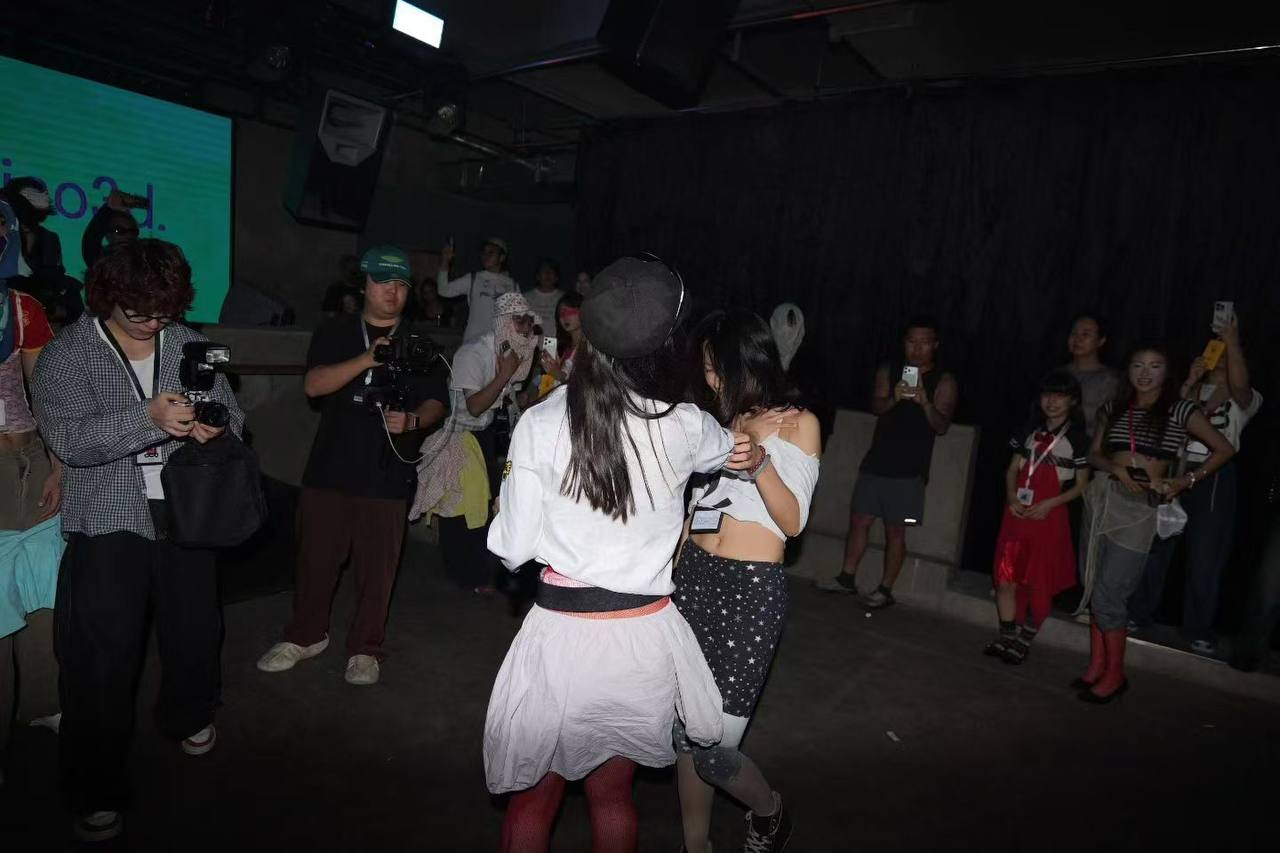
You sent me the unfinished version of your upcoming album, 003 (2026). There’s a lot of variety on there: dubstep, 2-step, electroclash, deconstructed club, the one track that’s glitchy and has field recordings of people giggling. What did you want to do with this project? And I know you posted flyers for people to participate in the album event as well. What’s happening with that?
001 was more of a narrative—it was about documenting things that were happening in my life and the different feelings I had. 003 is more about creating a sort of argumentation. It’s about the things I’m forced to do, and I want to discuss and challenge why I have to do them. For example, the one song, “uan1h.ing2y.uang1g.in2l” [欢迎光临 aka “Welcome”] is about how my father wants me to get a job. There’s a new song that samples a Chinese AI translator app. Although I can speak some English, there’s still a big cultural gap. When I’m at the supermarket, for example, I won’t understand some of the labels and I’ll have to ask the AI to translate for me. I was thinking to myself, why do I always have to ask the AI? I wanted to archive these things, classify them, and turn them into specific [talking] points that people could discuss. And on October 24th, I’ll hold an album-release party in New York, and Evol will host one in Chongqing on the same day. My idea is to have a group of people in the venue, and some will take an exam while others will act as teachers and proctors. Evol, for her party, is going to get some aunties who will dance. She already sent the demo to them and they’ve been rehearsing. I want to combine all these different actions, I want to interact with the audience—I want everyone to be part of the performance.
Do you have any thoughts on New York now that you’ve been here for a bit?
I don’t really have any thoughts right now. I feel more at home in China—it’s less stressful there. But I like to communicate with the world, and I want to perform in different regions and countries. Still, in terms of where I’d want to settle, I’d like to be in Chengdu or Chongqing. I’d like to have my own house there. Like, I’d love to go on tour and just come back and eat hot pot with my friends. That’d be nice.
I end all my interviews with the same question and I wanted to ask it to you. Do you mind sharing one thing you love about yourself?
I’m good at dealing with difficult situations. When I first arrived in New York everything was difficult—getting taxis, the Wi-Fi, everything. And actually, I don’t have enough money for this release party, but I found someone who’s going to do it with me—I found support. I make things work out.
No.006’s debut EP, 001, is out now on all streaming services. Their debut album, 006, is out on October 24th.
Thank you for reading the 242nd issue of Tone Glow. No.242.
If you appreciate what we do, please consider donating via Ko-fi or becoming a Patreon patron. Tone Glow is dedicated to forever providing its content for free, but please know that all our writers are paid for the work they do. All donations will be used for paying writers, and if we get enough money, Tone Glow will be able to publish issues more frequently.
They're so cool.