
Amy Sheffer
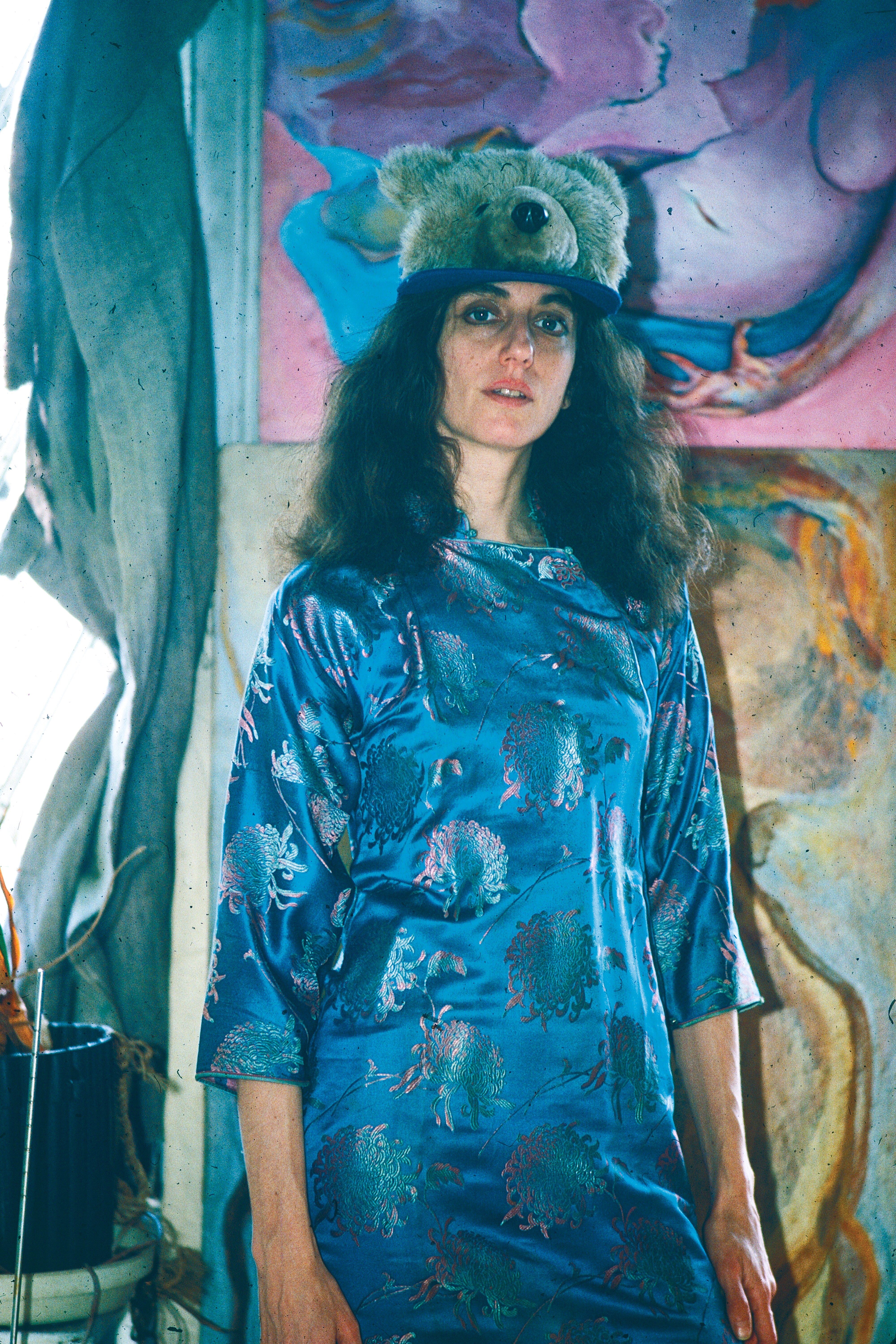
Even the most deeply-attuned ears of this new digital millennium would be forgiven for never having come across the name and musical world of Amy Sheffer, who until recently existed mostly as a featured-singer footnote in the discography of free-jazzer Marzette Watts. Those who clicked further to find out about Sheffer’s solo discography, a colorful trio of alluringly self-painted William-Blake-looking ’80s art-jazz albums—Sanctuary Mine (1980), Where’s Your Home? (1985), Wee’um (1987)—could find the LPs reselling every so often, but usually for rather unmanageably high prices. It seemed once every few years a SoulSeek’er would upload Sheffer’s song “Yellow Wings”—a standout hippie reverie that evokes Archie Shepp’s Blasé (1969) and foreshadows Jarboe-era Swans—to YouTube, only for it to be taken down weeks later. That was about all the crumbs of Sheffer the internet had on easy offer.
Enter Freedom to Spend, who at the end of last year released the wondrously far-out 70-minute Amy Sheffer compilation I Am Shee: Original Recordings, 1979-1987. Matt Werth, who runs the parent label RVNG Intl., had apparently never heard of Sheffer until only a few years ago when, during a visit to the record store sheyeye in Niigata, Japan, he came across a copy of one of her LPs. Thanks to his and others’ work, listeners can now bask in the piano, sax, bass, string, and drum tapestries woven behind and around Amy Sheffer’s unique falsetto psychedelics. Werth also helped to organize a show of Sheffer’s artwork at White Columns last fall to coincide with the release. Max Carpenter talked with Amy about her music, art, and life over vegan food in the East Village this past spring on March 28th.
Max Carpenter: I first discovered your work years ago because of your involvement with Marzette Watts.
Amy Sheffer: Yeah.
And I’m curious because he’s also sort of a—
—very interesting
Very interesting figure, yeah.
He was a very strange man, very strange. He was the one who first got me into avant-garde music. I had just come to the Lower East Side in the late ’60s. I’m not sure how we met, but he was always chasing girls, you know? Constantly. My sister and I were involved with him. And, well, I sang, but I liked to sing more mainstream things like “Moon River.” But one day I heard Patty Waters’ rendition of “Black Is the Color of My True Love’s Hair.” When I heard it I was just blown away. I fell down on the floor and started crawling around. I said, “This is my soul sister.” I had this tremendous reaction to it. When I first met her at Marzette’s place she was so reserved. I thought, you are the one who did that? I couldn’t believe it. Marzette and her were practicing their cover of Ornette Coleman’s “Lonely Woman.” Patty Waters, you could say, made me comfortable with singing in a very far-out way.
Marzette and I got to be good friends, and we and some other musicians would often record these improvisatory sessions at his loft. One day, Marzette said there was a guy who was gonna start his own radio program on WBGO and he had listened to a tape of ours and was crazy about it. The guy wanted it to be his show’s opening theme. Marzette and this guy really liked the style of singing I did, and they wanted me to do more of it. When I did more of it, though, they didn’t like what I did at all. In the end I’m pretty sure they took it out. And that guy never got his show. Later on, Marzette married two women.
At the same time?
The same time. He married two sisters. I don’t know if they officially got married, but they both had children with him. They both had two children with him. So there were four children in all. It was very strange. And then he decided to go down to Atlanta, to Georgia. I thought, Two white sisters and you’re going to go down to the South? But Atlanta, Georgia, is different.
It’s not Alabama.
Yeah. It’s much more progressive. So, he went down there for a bit, and he came back up, and when he heard my record Where’s Your Home? (1985) he was so interested in it. He said it was one of the best things that he had heard in a while, you know? He was very enthused about it. At that time he was mostly working as a recording engineer. He had to support his four children and two wives. In the end they both left him and he was very distraught. Apparently one of them was gonna come back, but he had a heart attack and died before then. He died in an unhappy way.
Wow.
Mm-hmm.
You were saying that before you met him you were much less avant-garde in your taste. What was your musical background?
No, I wasn’t avant-garde at all. I played the violin as a child. I used to play that Vivaldi number that people play [Concerto No. 6 in A Minor]. Jayne Mansfield played it.
Jayne Mansfield played Vivaldi?
Yeah! When I was young, I was kind of flat-chested. I was late to develop. So naturally Jayne Mansfield became my idol. At some point—I think I was around twelve—I won a contest for young musicians in Long Island. I was supposed to put on a violin concert. But I would have to practice four, five, six hours a day for this. It was too much for me. That kind of discouraged me. Plus, at the time, I got to thinking that I was “creepy,” and that playing the violin was part of my creepiness.
You thought you were creepy?
Yeah. So that didn’t help. I mostly stopped playing. Once I started playing jazz later in life I did improvise some with it. I still have my old violin. I would like to play it again, but the bridge is always breaking, the strings are breaking, it doesn’t hold tuning. The violin is so close to the human voice.
Jumping to a wholly new topic: I read on a certain website that you did guided LSD therapy with the same therapist Cary Grant used to see.
Yeah, yeah, I did.
How did that come about?
Well, it was the ’60s. My cousin was taking LSD therapy and she lived right next door. So I was curious.
Was this before you met Marzette?
Before that. That therapy was actually what got me into taking my singing more seriously.
LSD?
Well, it was actually mostly the therapist’s wife. She used to come into the sessions, and she had heard I was a singer, and she encouraged me to pursue singing. The therapist, though—he used to mostly just talk to me about his life.
His life?
Yeah.
Did you find it interesting?
Yeah. It was all about people taking acid and this and that. I used to concentrate on him for a while and he would appear to grow really long. Sometimes I would look down at my hand and it would look like a pig’s foot, but I wouldn’t really say that I was hallucinating too intensely. Anyway, those sessions changed my way of approaching art. After that I would just sit in my apartment and hallucinate paintings.
So acid was a turning point for you?
In some ways. But later, when I took Tibetan herbs—that was really a major turning point.
What do you mean by Tibetan herbs?
Well, the Dalai Lama had a doctor called Yeshi Dhonden, and Yeshi Dhonden used to come to New York. My friend, who was half-Mongolian and half-Hungarian—she was born in a concentration camp, or something like that—she identified a great deal with Tibetans and she knew all these Tibetans, so she was always having Tibetans around. She used to take me to all kinds of Tibetan events.
I had this condition that I was dealing with where I was bleeding from my breast. I was getting operated on. I started taking herbs that Yeshi Dhonden prescribed me, and the herbs were realllllly strong. They really put me into this whole other world. I was interested in psychic experience before then, but once I got into taking those herbs it was like another dimension of life. Wow! So that was even more significant than the LSD, and I took them for quite a while.
Did you take them during the time you were releasing music?
Yeah. I was pretty into all sorts of mind expansion stuff. I would say that’s really lacking in my life now.
Drugs?
No, mind expansion. Other than my paintings. My artwork is so necessary for me because I have these intense neuroses. I have body dysmorphia and stuff. So my art is so necessary for me to get out of that sort of preoccupied way of thinking. Throughout my life I’ve had this terrible fear of normality. Normality, or what’s supposed to be normal, is actually frightening a lot of the time. And, on the other hand, there’s this terrible fear of insanity, which can also be very frightening. Now in the world you see insanity and normality merging in this frightening and confusing way. I feel like what avant-garde music is doing is it’s breaking into that state where normality and insanity are mixed up; it’s breaking through the façade.
Absolutely.
I wanted to break through the façade.


Let’s talk a bit about your artistic background. You originally studied art, right
Well, first I went to Cornell. That didn’t work out.
Why didn’t it work out?
I couldn’t deal with it. Their art program was really into Bauhaus at the time, so they would tell you to just take some lines and make stripes, this and that, but I just wasn’t into that at all. I liked to draw from models. I did sculpture too, but at Cornell it was always make an “abstract” sculpture, you know? It was just not anything that I—it was just like a whole different subject.
So you went there for visual art?
Yeah. I went there as an artist. That’s how I got in. I didn’t have that high an average. Then I transferred to Cooper Union. It was the same thing as Cornell: very abstract. And I had a horrible experience in a class one day. The teacher said to the whole class, “Amy’s art looks like Amy. When you see it from far away, it looks good, but when you come close you see all the pimples and freckles on her face.” It was awful.
That would ruin me.
It did. But the thing was those Cooper Union art teachers were all like that. They would come and say, “You people think you’re artists, but you’re not!” I couldn’t really exist in that environment.
So you left Cooper Union as well?
Well, they wanted me out, too, because I was always protesting.
Protesting politically?
No, just against the program. Anyhow, then I went to NYU. Those other schools were difficult to get into. NYU was, at that time, easy to get into. I went to the School of Education and the art program there—I really liked it. You could do whatever. You’d get a project and you could do it the way you wanted, whatever it was. I was happy there. But I wasn’t happy with the teaching, because, first of all, I didn’t like teachers. And I certainly didn’t know why I was becoming one. I actually did work as a substitute teacher after that, for a lot of my life.
You first record, Sanctuary Mine (1980)—how did that come about?
Well, I was putting on concerts.
And these were with ensembles?
Yeah, with William Parker and different people—people on the Lower East Side, which was like a hotbed of avant-garde music. There were lots of people to do things with. Steve Tintweiss. Kenny Gill.
Kenny Gill is another person you’re associated with, like Marzette Watts, who seems to have had a very interesting aura.
He had one wonderful record [What Was, What Is, What Will Be (1971)]. So him being on my records—I think those are some of his only other recordings. He was a terrific player and he died terribly young, of heroin. He did not want to play electric piano and, consequently, he didn’t get many opportunities to play. He had this beautiful grand piano, and he had this beautiful apartment. And he had parties and sessions there. He used to play with Curtis Fields. They used to play restaurants. He was really studying music too—I remember he liked playing Ravel better than Debussy—but he just wasn’t getting enough gigs without playing electric piano.
When you performed with ensembles was this music you had written or was it more improvised?
I had started writing my own music. I wanted to get a piano, so I got a piano and used it to write and practice. First, I was playing with Steve Tintweiss and the Purple Why.
Do you know around what year this would have been?
Late ’60s. Steve had two vocalists. He used me and Judy Stuart. And we used to play my tunes too. I had one called “Deeper, Deeper.” That was a tune about hypnosis that was supposed to put listeners into a hypnotic trance, because I lived with this man who was into hypnosis. He used to hypnotize me.
You would hypnotize the audience?
Oh, I’m not sure people actually went into a trance. And then I had written “Yellow Wings,” so we used to do that one too.
So when did you decide you wanted to do a solo record?
Oh, well I was just putting on concerts and I felt like I wasn’t really making any steps to reach another level. I was just staying there. You know what I mean? I wasn’t a trained musician. Nobody really respected me that much, and I had tremendous respect for the musicians. They could do far more than me. I thought if I made a recording that would take things to another level and I would be more of a serious musician that way. I just thought why not?
Mm-hmm.
See, a lot of people I knew who were musicians, they never took a chance the way I did. I figured, what the hell, you know? My art, my paintings, I took very seriously, but my music was more like a kind of—I thought I was really far out because I could only do what I could do.
Say more about that.
Well, I could just do what I did. I didn’t feel like I was disciplined.
So you felt more free in music because it wasn’t your main discipline?
I just felt free to do whatever. Although my first record, Sanctuary Mine, is actually a pretty composed thing. I had somebody—John Disselt—write arrangements. I had all of these people I was playing with who wanted to do a record. And I could pay them because my parents had money. I thought I would move to another higher level if I did that.
And did you feel like you were on another level when you released it?
Well, I was on another level because I was reviewed! It was distributed all around the world. It was played on radio stations.
Do you remember how many records you put out?
500.
So you decided you want to keep releasing records after that?
Well, then I had my piano. I lived on the fifth floor of a walk-up. So they had to bring the piano up and in through the window. That was when I got very interested in writing music. I got very interested in composing.
Were there any people you were listening to around that time that were influencing your piano compositions?
I wouldn’t say that. No. I was just doing what I could do. I mean, I began to play more piano, but at that time I was just doing one-note composing. I was writing in the treble clef because I knew that from the violin. So I had a piano there, and then I had a really lousy set of drums, but it was still a drum set, so people would come over and play with me. John Disselt used to come over a lot and play with me, and then so would David Durrah and Butch Johnson. At the time they were homeless, they were squatting. They had both played on some incredible records, and with B.B. King and James Brown and stuff, but they weren’t doing so well at the time. They used to come over almost everyday to play the piano. That’s when the song “Where’s Your Home?” came about.
So you would sing with them?
Yeah.
Would you sing what you had written or were you mostly improvising?
No, it was a lot of improvising actually. When we did the record Where’s Your Home? I knew about a studio. I said, “Let’s go up to the studio and see if we can record this. Let’s see what happens.” So we went up there and we met Chakaq Johnson, the drummer, and he really liked what we were doing, so he joined us. And he had us all get in a circle together and pray it would come out well. It was quite an unusual, bombastic type of record. That one I wish I had made more of because it was actually very popular and people keep wanting copies. I only made 300. I didn’t have enough, you know? There was a big write-up of it in Spin. That was kind of a big deal.
Going back a little bit. You had said there’s a little bit less mind expansion in your life now than there once was.
There’s very little mind expansion in my life outside of my artwork and my music. I’m an 81-year-old woman with two roommates and I’m trying to get along with them. I don’t wanna bother people the way I might have bothered people when I was younger. I’ve got body dysmorphia, I’ve got insomnia, so mostly I’m just trying to keep myself together, do some shopping, take care of the house. My one tremendous love—my tremendous relationship is with my dog.
What kind of dog?
Oh, he’s a chihuahua mix.
Very cute.
But it’s not like I’m in the psychic realm I used to be in. You know? I mean, it was like I would go around talking to people who weren’t there and all that kind of stuff. I’d have strange visitations. It was weird. Back in the day I went to a therapist and they showed me what the therapist had written about me: he had said “possibly psychotic.” I felt very involved with the cosmos back then. Where I’m living now in Great Neck, it’s not very far-out. And my life is, you know, just getting through the day: I wish my housekeeping was better; I hope I don’t have to take too many pills to go to sleep; or, do I have to take another shower?
I think back to when I was younger, at one point I was living in Inwood. I lived in a place where there wasn’t hot water except in the middle of the night. And I used to get up in the middle of the night every night, think nothing of it, take a shower, and then go back to sleep. It was just a much weirder way of living when I was younger. In Inwood I was always walking in the forest.
The forest there is incredible.
I would just wander through the forest. There would be strange people I passed. Nobody normal was there. It was different. But now I get up and it’s not so strange, so I immediately wanna get to painting. Eventually I go to sleep. I’m thinking about my music, about my art. My music and my art is still my big thing. Other than that, my life is, you know, loving my dog.
Amy Sheffer’s compilation, I Am Shee: Original Recordings, 1979-1987, is out now via Freedom to Spend.
Thank you for reading the 232nd issue of Tone Glow. Music, art, dogs.
If you appreciate what we do, please consider donating via Ko-fi or becoming a Patreon patron. Tone Glow is dedicated to forever providing its content for free, but please know that all our writers are paid for the work they do. All donations will be used for paying writers, and if we get enough money, Tone Glow will be able to publish issues more frequently.
Much appreciation for this insightful and intriguing article on Amy Sheffer. Looking forward to her next exhibit at White Columns where she bought the house down with her paintings and onsite performances attracting quite a diverse audience.