
Éric Baudelaire
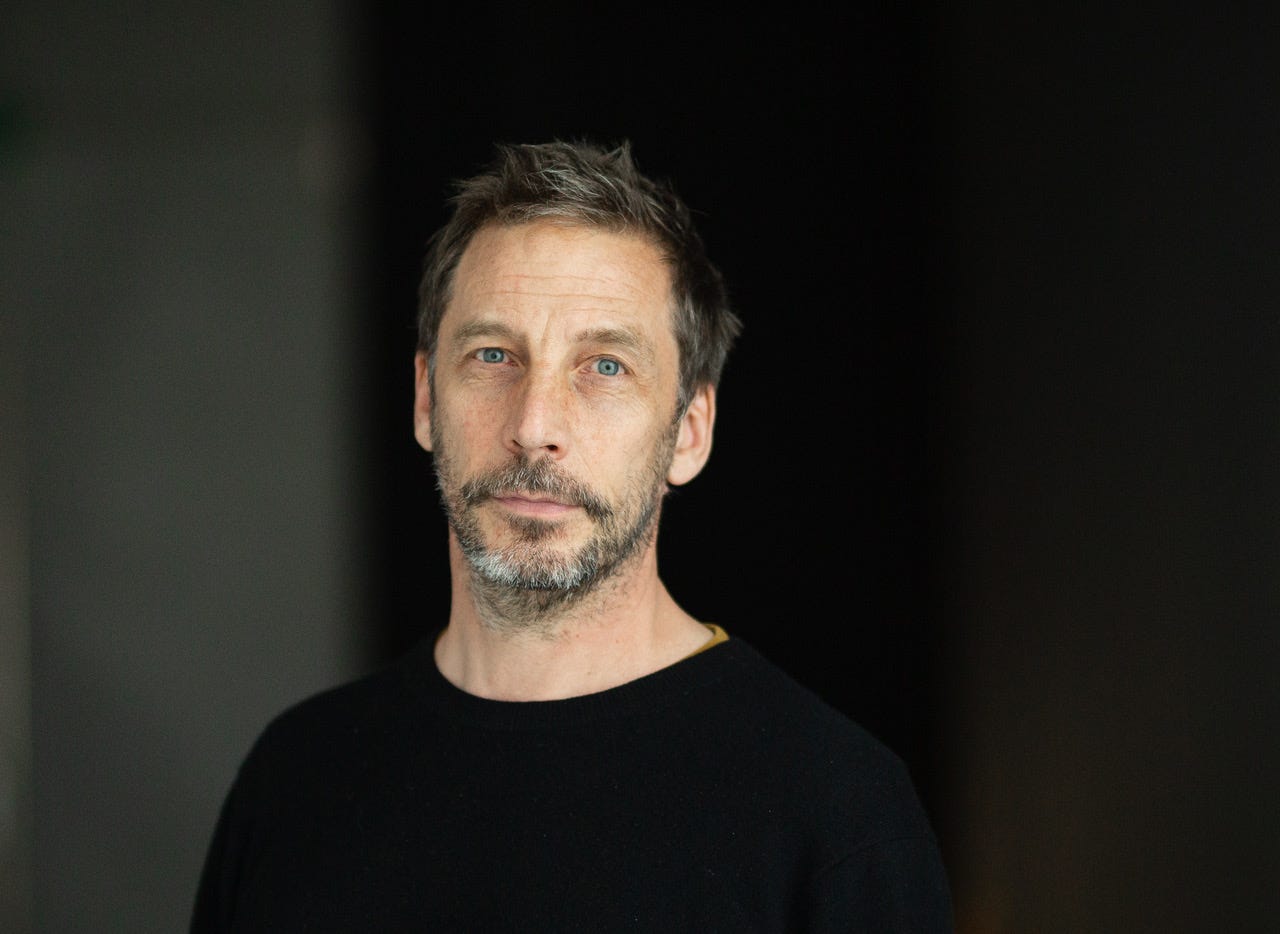
Éric Baudelaire (b. 1973) is a French visual artist and filmmaker based in Paris. Trained as a political scientist during the 1990s, he eventually found a deeper interest in photography during research trips. He’d soon start making films, releasing the structuralist work Sugar Water in 2007. While living in Japan in 2008, he worked on The Anabasis of May and Fusako Shigenobu, Masao Adachi, and 27 Years Without Images (2011), a documentary featuring interviews with the titular artists and activists while adopting Adachi’s own ideas about “landscape theory.” In the years since, he’s released numerous films—including Letters to Max (2014), Also Known as Jihadi (2017), Un film dramatique (2019),and A Flower in the Mouth (2022)—alongside other installation works and publications.
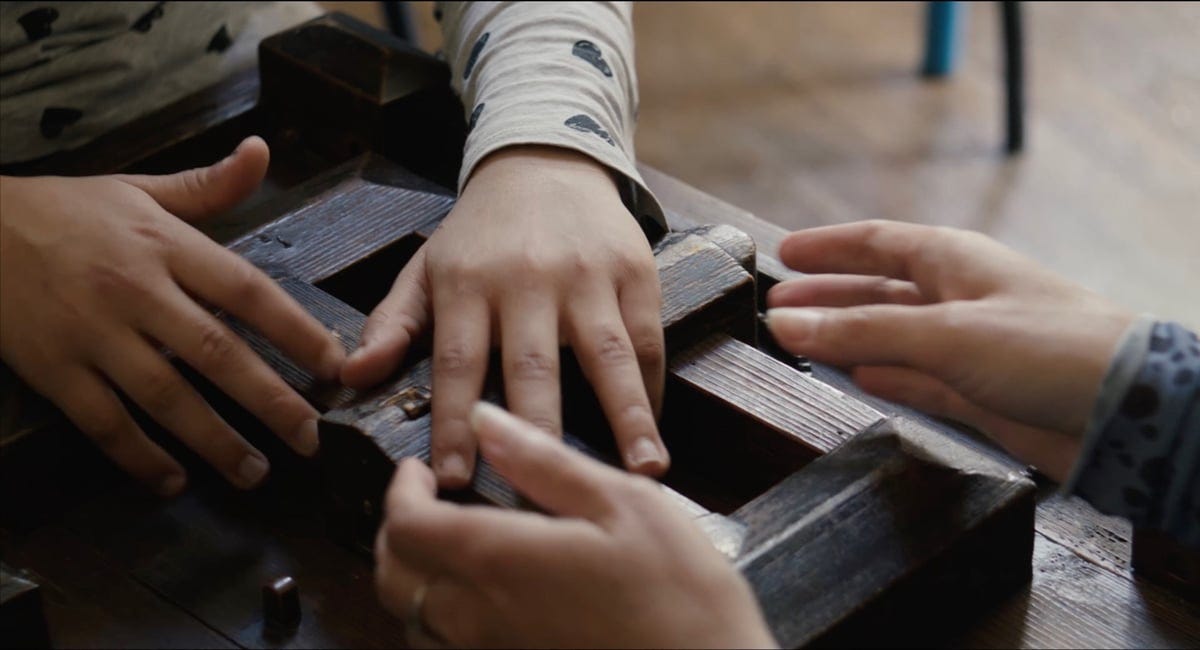
Baudelaire’s latest documentary is For the Moon (2026), a stirring feature-length film made in collaboration with students at the National Institute for Blind Youth in Paris. Freely allowing these students to film, he weaves their images with ones he shot himself, examining and interrogating ideas surrounding perception, expression, and creativity. The film, released by Cinema Guild, premieres at this year’s edition of the New York Film Festival. Joshua Minsoo Kim spoke with Baudelaire on October 4th, 2026 via Zoom while the filmmaker was in New York to discuss what he learned from Masao Adachi, crafting image-based works in today’s image-inundated landscape, and the ideas that informed his latest film.
Joshua Minsoo Kim: I know you do a lot of research for your films and that there’s a lot of preparatory work in general. Do you recall the first time you really fell in love with honing in on a topic and enjoying that process?
Éric Baudelaire: Prior to being a filmmaker I was a social scientist. I was interested in the social sciences because it was a methodology that allowed me to try and understand the turmoil of the world. When I began filmmaking, I held on to this idea that one’s process is about spending time thinking about the political anxiety we have and the situations that concern us. Filmmaking became the form to express this research, and I think my approach has evolved over the years in the sense that I don’t think it’s important to be a specialist in the subject matters that my films deal with. Sometimes it’s actually quite helpful to have areas that you do not understand, and that’s because the films are also about discovery.
With your experience in social science, I know you did research for The Kennedy Tapes (1997) book. That was in your mid-20s. Were you ever interested in film and filmmaking prior to that?
I grew up in a context where you prepared yourself, through education, for a job that could provide stability and safety. I always loved watching films, but I don’t think I felt authorized when I was young to imagine a career as a filmmaker. I had to go through this first stage of a professional life before I could imagine doing something outside of that safe space of salaried work. I don’t know why that is, as there were plenty of people around me who knew they wanted to be filmmakers. I went through photography, primarily, for learning how to make images, to understand images, and to learn to understand the mystery of images. Then the images began to move, but it was a very gradual process—it allowed me to start making films without ever deciding to be a filmmaker.
You had the Imagined States book in 2005 and then released your first film, Sugar Water, in 2007. It felt like a natural transition into filmmaking. That film is fascinating to me because I see it in the lineage of structural filmmaking, and in particular the works of Sharon Lockhart. Do you mind talking about that transition from still image to moving image?
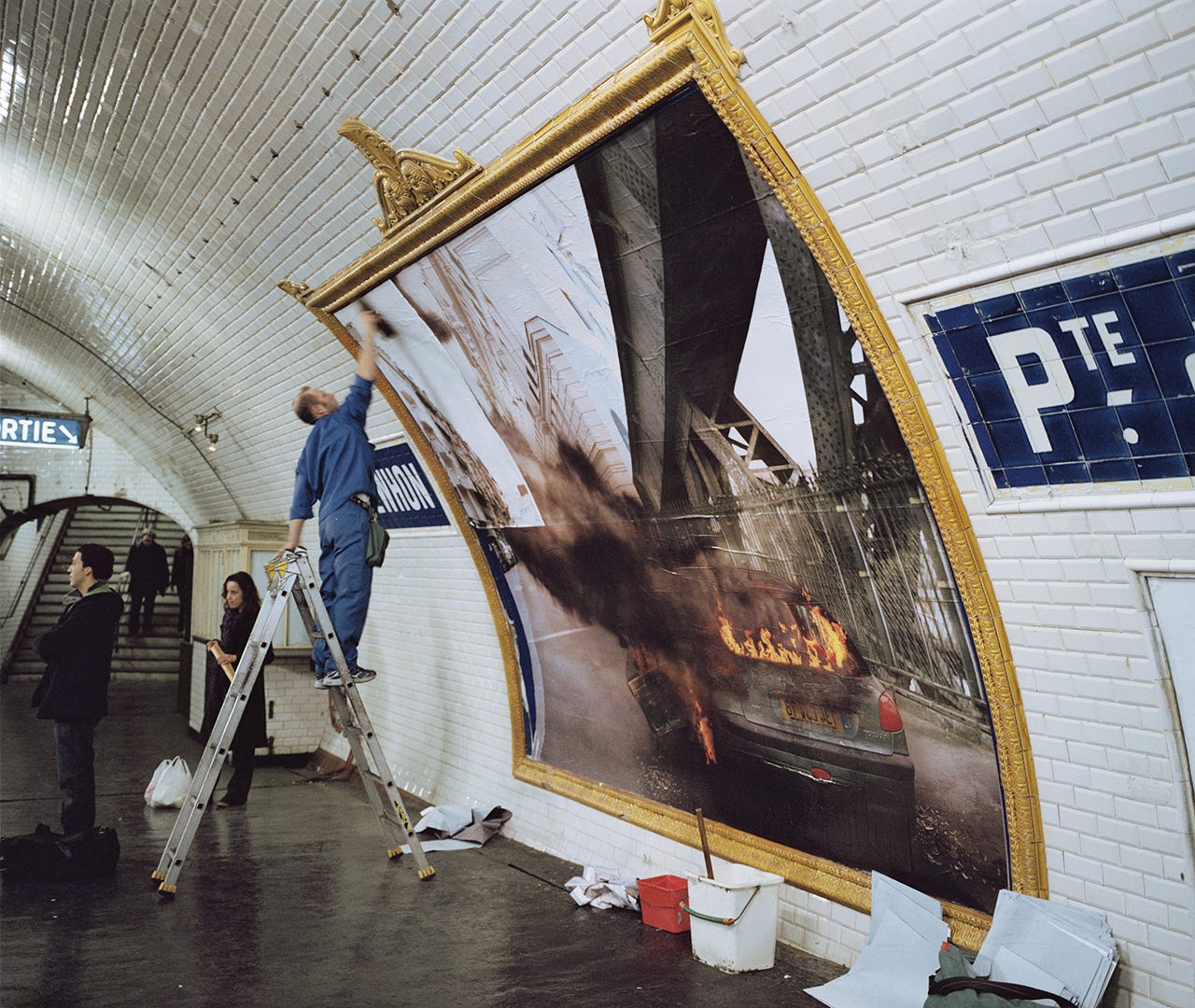
Sugar Water is a film without editing—it’s a long take of a man in a subway station. He’s a billposter and he’s wheatpasting images inside of a large 4x3 meter frame, which is where publicities are shown in the French metro. It started out as an idea, that the film would show a series of images of a car that is parked on the street, and then it would explode, and then it would burn, and then it’s just a carcass of a burned car. It’s a series of images that are connected to the experience of 9/11, the experience of the War in Iraq, and car bombings—the many images of violence that were being blasted at us throughout that decade. I wanted to slow the pace down—for the wheatpaster to patiently layer these images on top of one another, sort of like a performance, albeit one inside of a subway station in a film.
It’s a piece that’s very much about the still image—I think it takes roughly 13 minutes to fully cover the preceding image with a new one. It’s a slow-motion animation. I don’t think I necessarily thought of it as a film so much as an animated photograph or like a performance, but once it was finished, it lasted 72 minutes and I guess it was a film. I found that I had made a film while simply trying to think through this experience in the subway. I had just moved back to Paris from New York, where I lived during September 11th. I needed to get out of New York. With distance and time, I had a desire for this meditative piece, and making it authorized me to continue experimenting: I would film performances with video, asking people to perform certain gestures. Slowly I made a couple other short films, and by then I’d learned enough that I thought it’d be possible to make a feature film with [The Anabasis of May and Fusako Shigenobu, Masao Adachi, and 27 Years Without Images] (2011).
Why did you need to leave New York?
It was intimidating to imagine being an artist in New York. I lived here for eight years, I’d seen a lot of art, but it felt impossible to live in the pace of the city, at the expense of the city, while throwing everything out the window and starting with a blank slate at age 30. I thought it’d be simpler to return home to Paris and to experience this tabula rasa from my hometown. That was the idea, and I think it was good to start afresh at 30 in Paris. Paris was a very sleepy town in 2003—at the time it was provincial—and now it’s become a more interesting place for artists and filmmakers to live. I think it was helpful for me to be home, to turn this new page.
How do you think your filmmaking process developed throughout the 2010s? With Anabasis, you’re applying Adachi’s landscape theory which then arises in your later films, especially Also Known as Jihadi (2017). I’m curious how you feel you’ve grown.
Sugar Water was followed by [sic] (2010) and then The Makes (2011). By then it’s three films where I’m using a camera, directing characters or actors, and editing. I’m now feeling more able to think about the filmmaking medium to tell broader stories. When I was living in Japan in 2008, I came across this story about the Japanese Red Army. This was a radical underground movement that turned to armed struggle in solidarity with the Palestinian cause, but from Japan. This, I think, spoke to the former political scientist in me. This was a period of history I was very interested in during my prior life, but I had never heard of this Japanese chapter of the rebellious ’60s and ’70s.
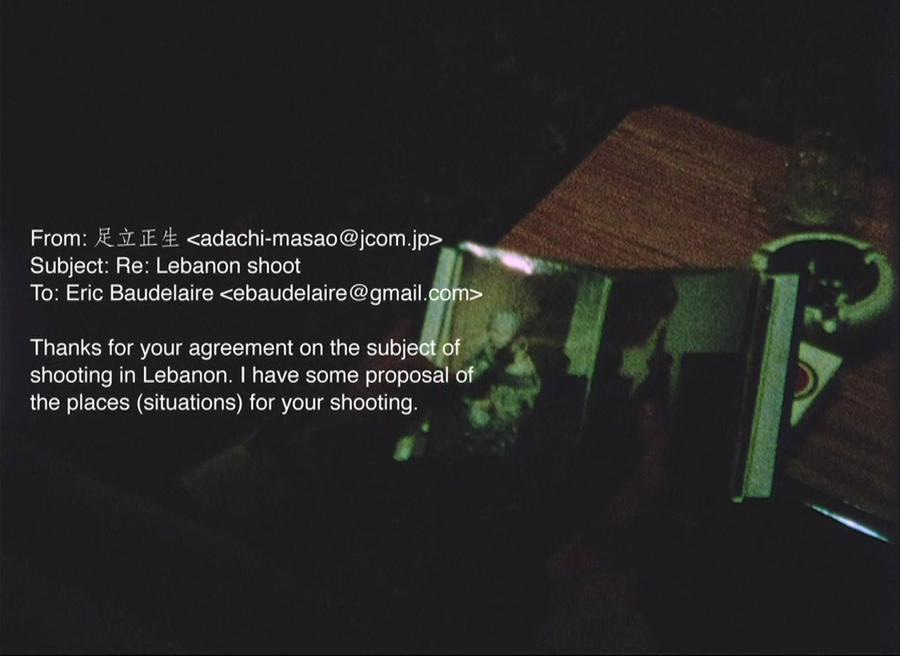
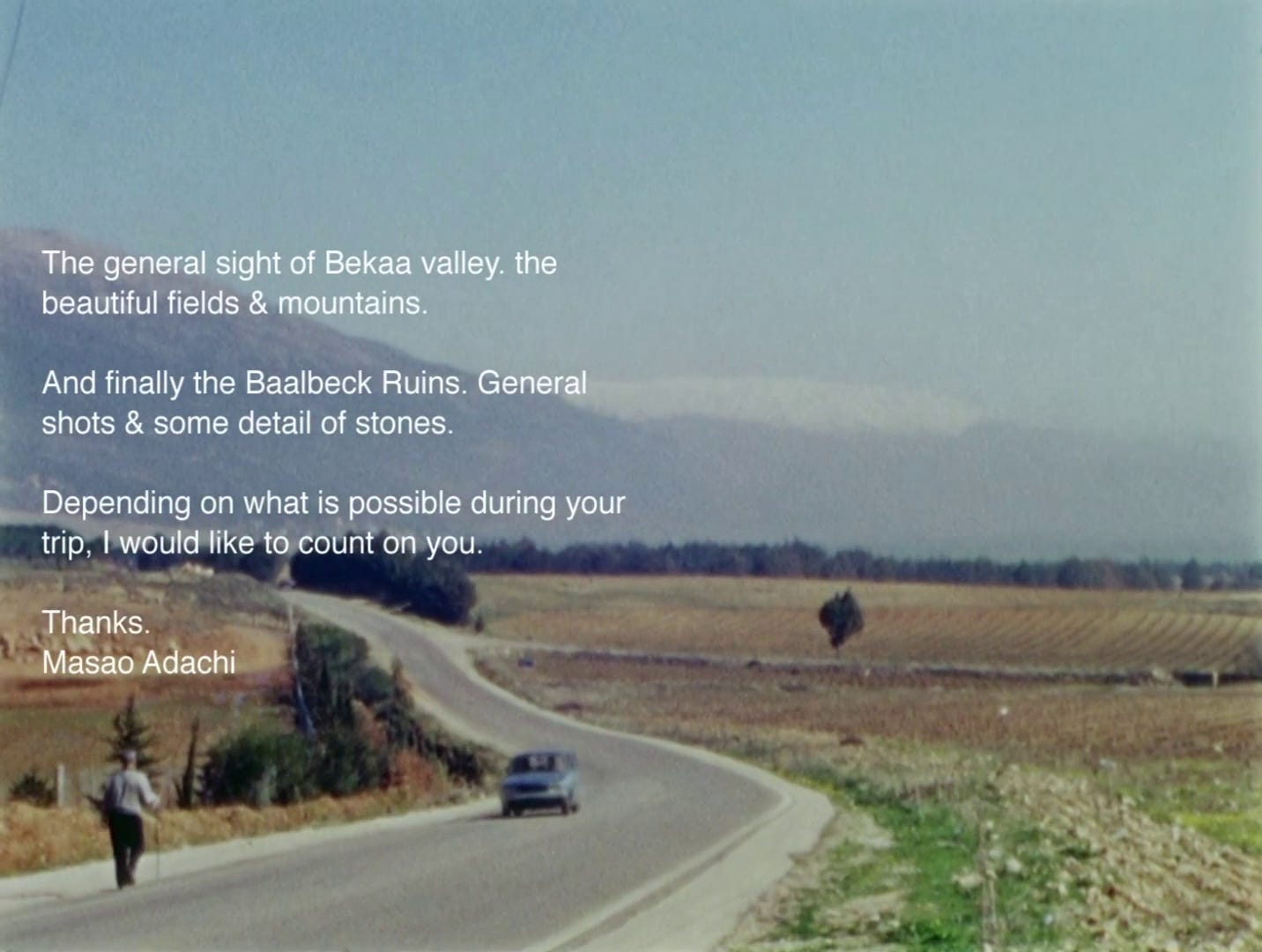
I started interviewing May Shigenobu, watching films by Masao Adachi, and I took a couple of years to invent a form for this film. This was a form that I could accomplish by myself—filming in Super 8, editing on my own—and work through a number of problems related to filmmaking. For example, how do you tell a story from interview material without turning it into a talking heads documentary that is biographical in ambition? It was clear that I did not want to do a conventional documentary about the Japanese Red Army. These three years were like a laboratory, like a film school, for thinking about the theories that Masao Adachi had himself explored. This was the basis from which my future films were going to be born, and it’s because I felt like I found a way to tell stories that were mine.
Have your thoughts on filmmaking shifted given the way that technology has evolved? I’m a high school teacher for my day job and over the past decade I’ve seen how much has changed, especially given that so many of my students can have upwards of 18 hours of screentime a day. Then there’s the literacy crisis and, since they mostly use apps, there’s a tech illiteracy because they don’t really search for things on their phone—and Google has been worse than ever, too. How do you communicate information in the present day given this landscape of image inundation?
One thing I’m sure of is that the solution is not to imitate TikTok or to adopt the attributes of the media being consumed by a generation who is not reading books anymore. I’ve also found that there is a counterreaction. There are a lot of people who grew up in this COVID era who are thirsty for different forms of moving images, who are very eager for counterexamples to the way social media functions. These are the same young people who use flip phones, who turn off their screens, and are increasingly politically mobilized. If you look at what’s happening in France right now, it’s high school students who are in the streets, protesting very strongly against certain conditions and the slow destruction of public education due to funding cuts—and this is happening at a time when the billionaire class is confiscating resources and defunding public schools. The high school students are in the streets, they’re demonstrating.
Imagining forms of filmmaking that propose a different relationship to images, both in how they’re made and how they’re watched, is a relevant way of proposing something today. Perhaps one of the reasons why I’ve drifted towards collaborative forms of filmmaking with teenagers, including with For the Moon (2026), is because it’s one solution. The teenagers I work with are eager to make images with me. We just need to break the tyranny of how mainstream image consumption is occurring and propose counterexamples, and then there will be people who are drawn to this.
So this notion—that the way forward is not to replicate TikTok—is more about providing another avenue to stoke curiosity and intrigue, and less about the form of short-form vertical-video content?
I don’t think it’s just short-form vertical-video content. It’s the way TV series have modulated our approach to narrative in general. It’s this idea that every narrative structure has to be based on a cliffhanger, that it’s an episodic cycle, that your attention is drawn via Foley. There’s this idea today that successful media doesn’t give you any other alternative than to be with it for hours, for seasons, and to not have time to think for yourself. You are guided by the virtuosity of the editing, the script, and the post-production.
This media doesn’t leave a lot of space for individuals to exist within their relationship to the media. We are taken by both hands and run through this rollercoaster, which is very pleasant and enjoyable, but I also think there’s a thirst for other forms of imagemaking that give people space to think and to not be sure of what they’re watching, for people to project different types of meaning on top of these images. I’m talking about imagemaking that leaves a space for the spectator to be present, to experience time. There will always be an audience for this. This is not necessarily a counter-proposal to dominant imagemaking forms; I think it’s something that humans have always been interested in, and it’s cross-generational as well.
When you show films at the Jeonju Film Festival in Korea, for example, it’s amazing. The program is extremely dense—there could be five or six different films at the same time slot in the day in this relatively small city. The movie theaters are full! Many of the people in the audience are quite young and many travel to Jeonju to see the films. They want to see them. There’s a hunger for these different forms of narrative; we just need to protect the economic possibility of making and watching these films.
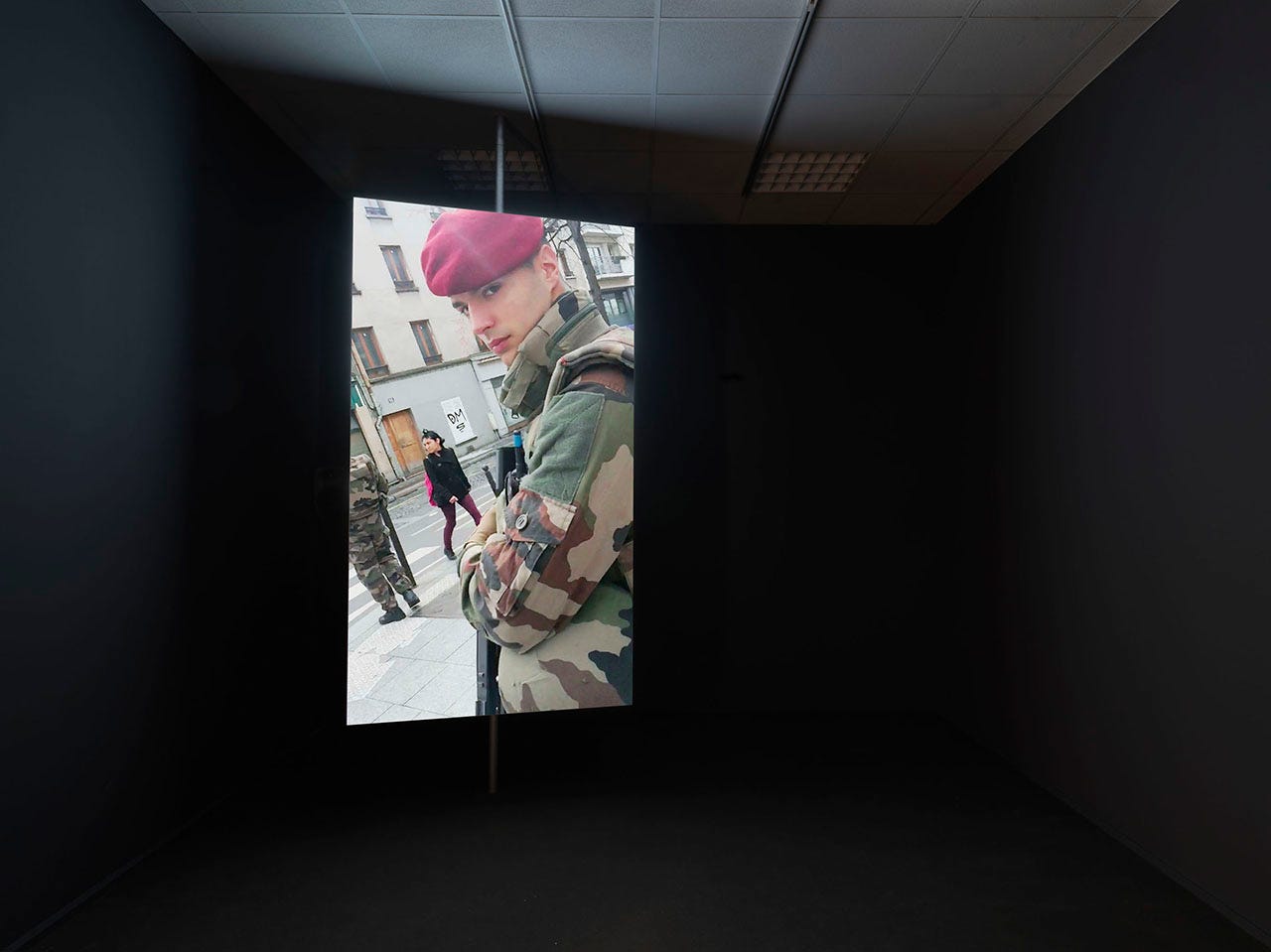
Based on what you’re saying, it seems that a lot of issues come down to people feeling like there’s only one correct way to interpret a film and that the viewer’s hand is being held throughout all this. When you said this, I immediately thought of your film A Flower in the Mouth (2022), which has a very explicit structure. I also thought of your phone film, Walked the Way Home (2018). Were you thinking about any of this stuff related to mainstream media consumption while making those works?
Walked the Way Home is interesting because it’s a phone film, it’s a vertical image. In many ways it’s a film that utilizes exactly what Instagram and TikTok utilizes—filming the world with your phone, vertically—except I do it in slow motion. What I filmed was soldiers in the streets of Paris around my studio, and then patrolling soldiers in Rome when I moved there. To see them on the streets with combat gear seemed an interesting problem to make a film about. We’re used to this militarized presence in our streets because it was introduced slowly, but there’s something unusual about armed soldiers, and I wanted to film them in slow motion at very close range. We edited these together into a long, slow piece—I think it’s about 40 minutes in total of footage. The music is by Alvin Curran, and it’s this melancholic, improvised electroacoustic music. So it’s TikTok but it’s anti-TikTok at the same time—it adopts the vocabulary but slows down the pace.
The second film you mentioned is A Flower in the Mouth. It starts with a play by Luigi Pirandello, a short, 20-minute one-act play. It’s very beautiful—it’s about a man with a tumor in his mouth called an epithelioma that is gradually killing him. He knows he’s gonna die. And so he spends his day wandering, observing daily life. Then at night he talks to a stranger at a bar and tells him his observations about life. The film has a diptych form. The second half is a filmed version of this theatrical performance, and the first half is 30 minutes of observational footage inside of a giant flower market in Holland, where industrial farms ship their flowers from Africa to this marketplace in Amsterdam and they’re sold at auction, repackaged, and sent across the world to flower stores. It’s a view of the industrialization of the flower industry and it’s beautiful because flowers are beautiful, but it’s also dreadful because the industrialized scale of this economic reality is daunting.
When you talked about these two films, you talked about this idea that films shouldn’t necessarily tell you how to think or what to feel. Filmmaking for me has more to do with being open to an experience of seeing images, hearing sounds, and having our body, in some sense, come up with possible interpretations that are open, not didactic, and don’t provide answers. This temporality is extremely different from the rapid pace of short-form media on telephones.
Earlier you mentioned Foley artists and how they’re directing the way you think about any particular sound. You also mentioned Alvin Curran. I’m curious about how your experiences with sound and music shape the way it appears in your work. When we think about the history of acousmatic music, not having clarity about the origin of a sound feels like a parallel experience to what you’re talking about regarding how you want your films to function.
Over the years, the most important thing I’ve learned is that when filmmaking associates sound and image in a seamless way, it makes the experience more intense. I’ve been more interested in disassociating sound and image so that the sounds that we hear do not correspond to what we’re seeing onscreen. There’s a space that emerges between sound and image, and that space is one for the viewer to inhabit and ask questions. It prevents you, to some extent, from having this intensely forward-moving experience; when sound and image go well together, you don’t have as much time to exist within the film. I’ve been interested in disassociating these two streams and creating attention and tension.
Do you remember when you first really accomplished that and felt really successful?
I think it was with the Anabasis. It was a film that was really important for me to edit myself because it taught me specifically about that space. Sometimes, May Shigenobu says something in the interview and I want to create a distance between the spectator and what she’s saying. I didn’t want the spectator to necessarily believe everything she was saying because her life is a fabrication: she lived a clandestine life for the first 27 years of her life. Everything had multiple meanings, and it felt important to me that when she gave this oral history—and it’s not an objective oral history, it’s very subjective—that I created a distance from her narrative. I did that by editing her sound to images that proposed something different from what she was saying. Then, between the sound and the image, a gap opens and you start thinking more critically about the story. This is something I’ve used in all my films since then as a way of making us think about what we’re seeing and hearing.
How is that happening in For the Moon then? It’s an interesting proposition given the students are blind. How were you thinking about this disjunction between image and sound in a film like this?
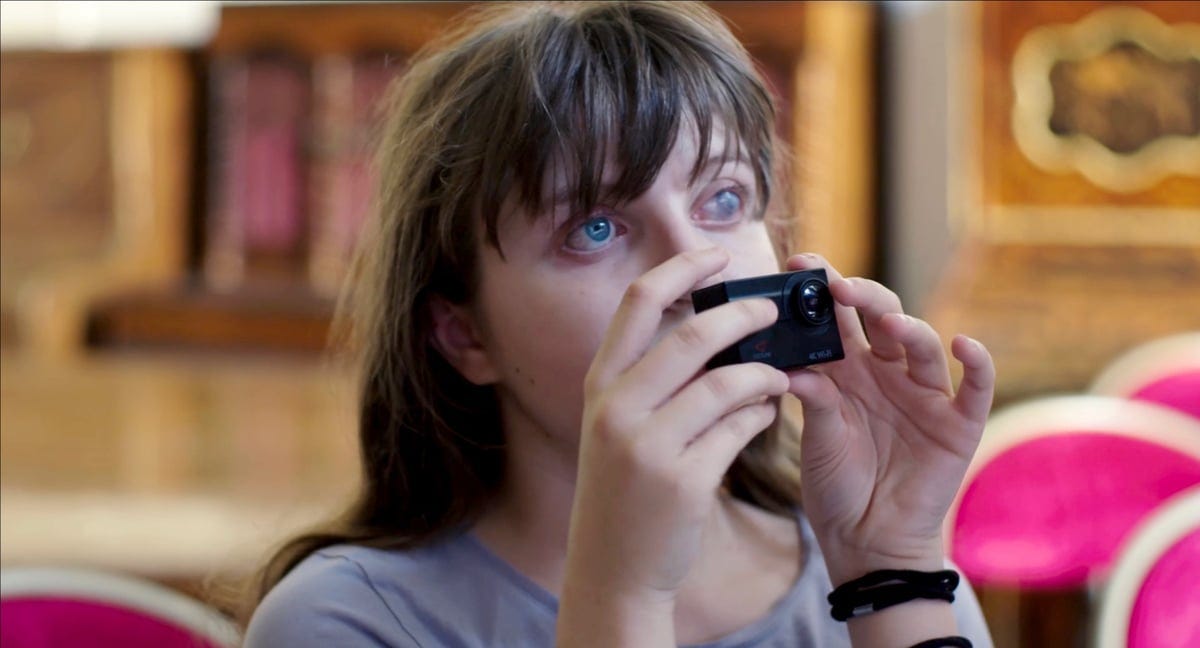
For the Moon is a film about perception altogether, so it’s not exactly happening in the way it was with the previous films. Here, it would have been inappropriate to work on that distance because, strictly speaking, the subjects and collaborators on the film are visually impaired. It has more to do with playing with the general notion of perception—both sound and image together. All of the students I made the film with have a deep engagement with films: they watch films, they watch series on TV, and they use the word “watched.” They were given cameras to film, and half the material in the film comes from images on their cameras. In editing with Claire Atherton, the conversation we were having was, “How can we make a film that doesn’t show us how they see or do not see, but instead shows how perception is extremely relative? How can we emphasize that everyone perceives things in a specific manner?”
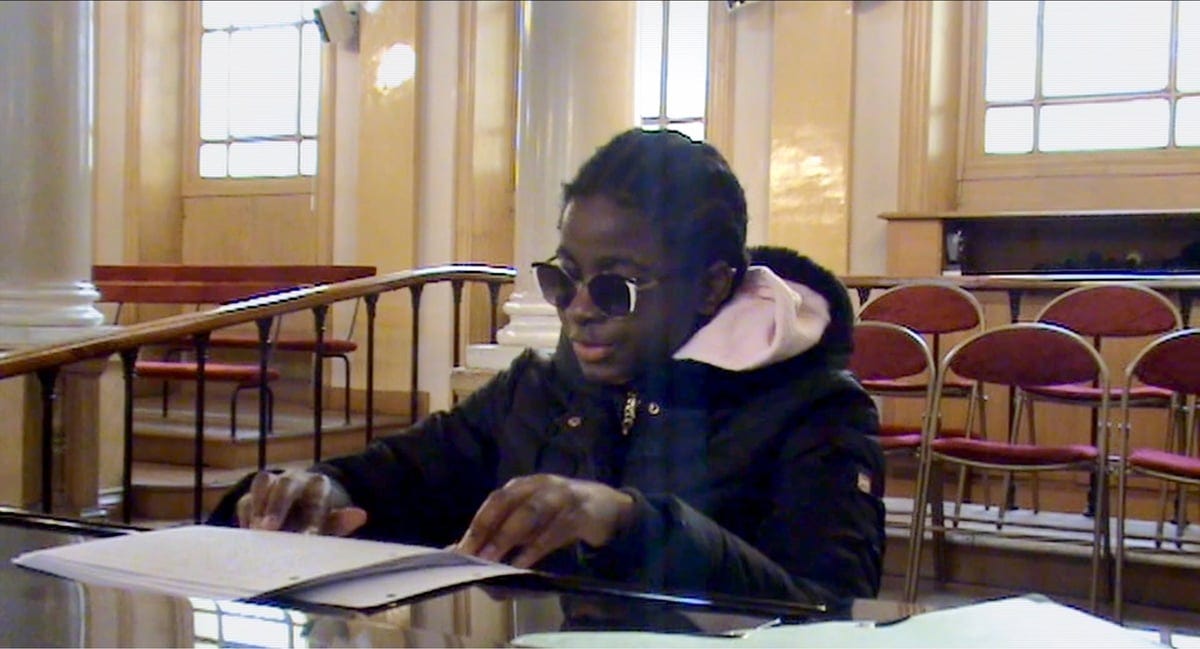
How much were you thinking about For the Moon being something for a typically sighted audience versus one that’s visually impaired? There’s a moment near the end when we hear an Aya Nakamura song and there’s these abstracted colors. It’s interesting to think about that in the lineage of avant-garde film, but it’s also something that anyone just experiences when they have their eyes closed and a bright light is in front of them.
At this point in the film, we are no longer making any suppositions about how any non-sighted people will view the film. We’re making a film that will be seen by those who see and those who do not see, and then we’re making an audio description but in collaboration with the subjects of the film to enhance the film for those who are non-sighted and want to have an audio description—and that’s because not all non-sighted people enjoy watching films with audio description. The coincidence of the sequence you’re talking about is that Iris had just lost her second eye and she was no longer able to see anything on the screen of the video camera, and the camera lost its focus and started pulsating around this LED light that shifts color. Her camera started to produce these abstract color variations that coincidentally mirror the phantom colors that she’s seeing in her mind after the operation where her second eye was removed. It’s a kind of serendipity, but it was also very beautiful. Sometimes filmmaking gives you these amazing coincidences and you have to do something with them in the edit.
What do you feel like you learned in making Un film dramatique (2019) that informed how you approached For the Moon? There are other films that have focused on children, such as those from Claire Simon. There are also films that grapple with those who are blind—there’s the Wiseman films, there’s the Herzog, there’s the BBC Channel 4 series Blind Young Things. I’m curious if you also looked to these other works as ways to think about For the Moon.
Un film dramatique taught me that if you trust kids with cameras and you don’t tell them what to do, they’ll bring back remarkable material. That lesson was simply applied to the students at this school. Initially, the way I worked was that I showed them excerpts from Un film dramatique to the student body as a whole. Then I asked if any would be interested in the filmmaking process. A handful of students, all girls, volunteered.
When we started meeting, at first I gave them little sound recorders—Zoom recorders—because I thought it would be natural for them to start with sound. Very quickly they responded, and I think they were even a little offended, saying, “Why are you giving us sound recorders? Because we’re blind? Film is sound and image—we want cameras.” That lasted about a week and I said “okay.” I gave them cameras, and they’re the ones who initiated the process. They did not want to be treated any differently from the students they had seen in Un film dramatique, and very quickly they proved to me that this was the right request. Their use of the camera was very interesting from the very first week they had them.
Can you give me an example? What stood out to you?
We live in an age when so many images are produced that the act of making an image isn’t as solemn as it used to be. Beforehand, you’d have a super 8 camera or a 16mm camera and you’d have to carefully unwrap the film, put it inside, and think about what you are filming, and then make very deliberate decisions about how much footage you were going to shoot. What the students made me feel was similar—everything they filmed was immensely precious. They had a camera in their hand, some of them see a little bit and some of them see nothing at all, but they had all made images. The weight of those images was very present because this was a deliberate action that they were engaged with. These were images that I would not see in the same way that they saw them, and it gave a particular importance to them, as well as a particular responsibility when editing them together to a filmic form.
I sense this care and preciousness when you see one girl teach another how to shoot with the camera. Something I’m curious about is if anything may have shifted when filming them in the same way you would typically see in another documentary setting. When someone has a camera upon them, they behave in a particular way because of that gaze, and I’m wondering if the same was true here. I imagine you always told them when you had the camera rolling?
So when I first went to the School for the Blind with the camera, I think it was one of the most complicated contexts I’ve ever filmed in. I went a large number of time without a camera at all, wondering if it’d even be possible to film there. When I began filming, I obviously informed people of what I was doing, but I also understood relatively quickly that the observational footage of the school itself was only going to be used at the beginning of the film. I wanted to take the spectator through this process of watching images inside of an institution for the blind, thinking about what it means to film people in this context, and then slowly moving towards a different type of image, which is one made by the students. The observational footage isn’t simply there to provide context—it’s there to provide the viewer with the complexity and difficulty of filming and watching these images, serving as a prelude to help us think differently about the images we see afterwards.
Do you think there was anything distinct about doing this at a French school? Is there anything unique to that? Maybe it’s just a bureaucratic thing and has to do with access.
I don’t think so, and it’s hard for me to know how schools work elsewhere. I know that it requires a high amount of intimacy, and it’s much easier to have this intimacy at home in my own language in a context that I understand very well. I wouldn’t be very comfortable doing this in another country. I also think that, in reverse, this is a film that would not have been possible had the five students I worked with not had the utmost trust in me. And for that to exist, I think there’s a necessity for linguistic and cultural proximity.
What did the editing process look like? Did you get the footage piecemeal? How did the shape of it emerge after you got everything?
Initially, I didn’t want to expect too much from the images they’d be filming because I knew there could’ve been a lot of time before something promising emerged. I was very laidback about what was being filmed early on. Very quickly, some beautiful things started to show up on the SD cards of these cameras. And that’s when I called Claire, my editor, and said, “I think we have a film here.”
Initially, I set out to do this without too many expectations, without setting out officially to make a feature-length film. I simply told Claire, “There’s some beautiful things happening here, let’s set some time in the fall to begin editing together.” And then I continued to work with the students: I received their images, looked at the images with them, and then handed the cameras back to them for a few more weeks. I told Claire that this was the intention that I had: I would start with the observational material, let this material ask all kinds of questions, and then gradually find a way to shift the perspective into telling these five students’ own stories.
And that’s essentially what happened. We worked with the images that they gave us and would sometimes go back to the camera held by my DOP, Claire Mathon. She would come once every two months and film the process of discussing the images and working with the girls. This helped us construct a film that’s about both their subjective experiences and the process of making the film.
How long was the entire process of you being at the school and filming?
Roughly two years from my first visit to the last tape that they shot.
You were talking about the importance of intimacy for being able to make this film. It reminds me of something you talked about once regarding Adachi. He told you that political revolutionaries may not know about love, emotion, sexuality, and pleasure, while artistic revolutionaries may not know about politics. I’m curious how this notion, of holding both these things, has informed your life and if it played a role at all in the way you thought about creating this film.
Adachi told me that there is something extremely important in risk-taking when making films. It’s important to make provocative propositions and let films stem from that. He also taught me that nothing’s impossible—it is not impossible to make a film with footage shot by blind students. What I knew about before but what Adachi confirmed is that politics and love are what nourish filmmaking, but you need both of them together—you have to feel like what you are doing has political meaning, but there has to be love in the process.
There’s a question I end all my interviews with and I wanted to ask it to you. Do you mind sharing one thing you love about yourself?
Oh wow (laughs then takes a long pause). This is a difficult question because last night I had a conversation here in New York with two old friends of mine that I hadn’t seen in a long time. I was telling them that, possibly, I value not having too much self-awareness—self-awareness may have prevented me from ever daring to make films. What I love about myself, or when there is love about myself, it’s in feeling lucky that I didn’t prevent myself from doing the things I do today. I very well could’ve spent an entire life without turning to these forms, and these forms have made me happy.
Éric Baudelaire’s newest film, For the Moon, premieres at this year’s New York Film Festival. More information about Baudelaire can be found at his website.
Thank you for reading the 75th issue of Film Show. The unexamined life makes a life worth living.
If you appreciate what we do, please consider donating via Ko-fi or becoming a Patreon patron. Film Show is dedicated to forever providing its content for free, but please know that all our writers are paid for the work they do. All donations will be used for paying writers, and if we get enough money, Film Show will be able to publish issues more frequently.